
ADSS cables rely on carefully matched hardware to stay secure without damaging their dielectric jackets. The right Adss Clamp depends on the cable’s diameter, route, support spacing, and expected mechanical load. A suspension clamp supports the cable along a straight span. A tension or dead-end clamp anchors it at a termination or major route change. Downlead clamps guide vertical cable runs along a pole, while storage clamps hold spare cable neatly for future work. The names can vary between manufacturers, so check product specifications before comparing types.
A verified expert quotation would make this overview stronger, but no source or expert name was supplied. To avoid presenting invented words as a real industry quotation, use this attribution only after verification: “[Expert name], [verified ADSS Clamp specialist], said, ‘[Insert a checked quotation about clamp selection or installation].’” It is a small but important distinction.
When comparing clamp designs, look beyond the label. Check the stated cable range, contact surfaces, material, and installation method. A compact wedge clamp may suit a termination, while a cushioned suspension assembly is built for a different role. Details matter. A clamp that fits loosely can allow movement; one selected outside its specified range may put undue pressure on the cable. These are not interchangeable parts.
This guide will explain the main Adss Clamp types, their typical uses, and the practical checks that help narrow a selection. Real installations still vary. Manufacturer guidance and site conditions should inform the final choice.
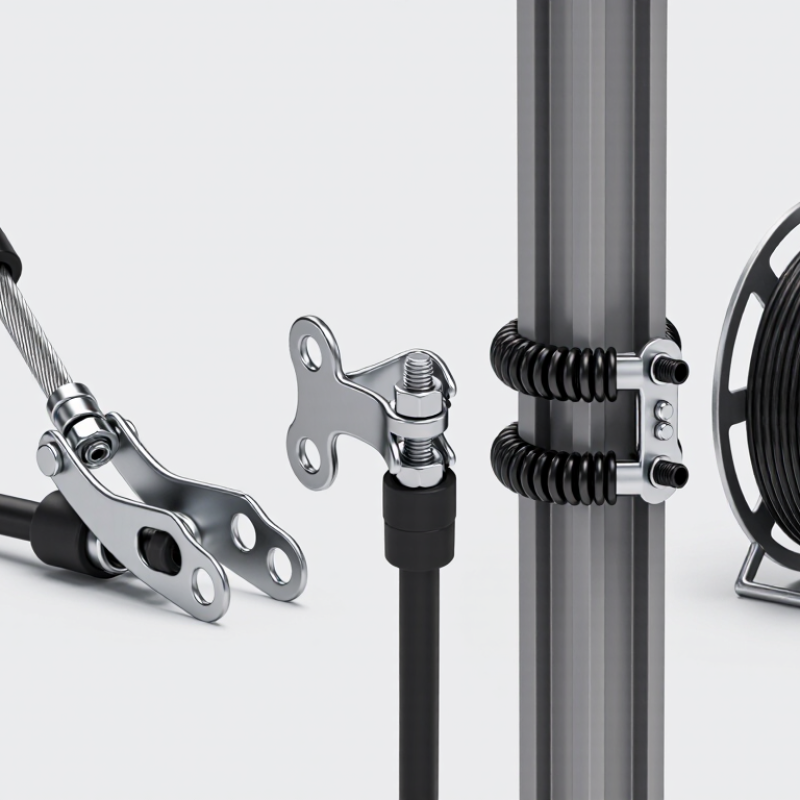
What Are the Top Types of ADSS Clamps?
How ADSS Clamps Support and Secure Aerial Fiber-Optic Cables
ADSS clamps keep self-supporting fiber cables positioned between poles without relying on a metallic messenger wire. Their role matters as connectivity expands: ITU’s Facts and Figures 2024 estimates that 5.5 billion people were online, about 68% of the world’s population. For an aerial span, the right hardware helps manage cable weight, wind, vibration, and tension. Small parts matter.
Suspension clamps support cables along straight routes, using shaped contact surfaces to limit pressure on the cable jacket. Dead-end, or anchoring, clamps hold cable at terminations and route changes, transferring longitudinal load to the pole structure. Downlead clamps guide cable down a pole and help prevent rubbing or loose loops. A loose grip can migrate. Too much compression can damage the sheath.
Clamp choice should match cable diameter, span length, route geometry, and calculated loading—not guesswork. IEEE Std 1222-2019 covers testing and performance for ADSS fiber-optic cable, while IEC 60794-4-20 addresses aerial ADSS cable requirements. These standards guide cable performance; they do not replace project-specific hardware selection. A practical oversight is treating every pole as identical. Rechecking the actual span and attachment point is worthwhile.
| ADSS Clamp Type | Primary Function | Typical Location | How It Supports or Secures the Cable | Key Selection Considerations |
|---|---|---|---|---|
| Suspension Clamp | Supports the cable at intermediate points along a route. | Tangent poles or towers where the route is relatively straight and does not require a full tension termination. | Holds the cable in a shaped cradle or grip. Some designs use a liner or armor rods to distribute contact pressure and help protect the cable. | Match the clamp to the cable diameter, span conditions, line angle, and the cable maker’s installation guidance. |
| Helical Dead-End (Tension) Clamp | Anchors the cable where longitudinal tensile load must be held. | Dead-end poles, route terminations, and other locations requiring an anchor point. | Preformed helical rods wrap around the cable and transfer tensile load to the supporting hardware over a distributed length. | Choose a design specified for the cable construction and diameter, required holding load, and installation conditions. |
| Wedge-Type Dead-End Clamp | Provides a mechanical anchor for compatible ADSS cable designs. | Dead-end structures or other designated tension points. | A wedge mechanism grips the cable within a housing as tension is applied. Cable contact and load transfer depend on the clamp design. | Use only a clamp approved for the cable type and diameter; follow specified installation and tensioning procedures. |
| Downlead Clamp | Guides and restrains cable running down a pole or structure. | Pole faces, tower legs, and transitions from an aerial route toward ground-level equipment. | Secures the cable at intervals to limit movement and maintain the intended route without serving as a span tension anchor. | Check cable diameter, mounting surface, required clearance, bend radius, and the installation plan for the transition. |
| Angle or Corner Support Clamp | Supports the cable where the route changes direction. | Poles or structures at line-angle locations, when the hardware design permits a supported rather than dead-end arrangement. | Provides a bearing and retention point suited to the direction of the cable path; the arrangement helps keep the cable in position through the turn. | Confirm allowable line angle and loading for the selected hardware. Larger angles or higher loads may require dead-end arrangements. |
Selection note: ADSS clamp choice depends on cable construction and diameter, span length, route geometry, expected mechanical loading, and the cable manufacturer’s specifications. ADSS cables are all-dielectric and do not use a metallic messenger wire as their support member.