
China’s Overlay Welded Pipe industry serves demanding applications in oil and gas, power generation, mining, and chemical processing. This guide examines ten manufacturers that attract attention for production capability, technical control, and export experience. The focus is practical, not promotional.
Overlay welded pipe combines a structural base pipe with a corrosion-resistant alloy layer. The result can resemble ordinary steel from a distance. Inside, however, welding quality, dilution control, and bond strength decide service performance. Buyers should examine cladding materials, such as nickel alloys, stainless steel, and cobalt-based grades. They should also review pipe sizes, wall thickness ranges, and applicable standards.
Quality evidence matters. Look for welding procedure qualifications, welder certifications, heat-treatment records, and traceable material certificates. Reliable suppliers should explain ultrasonic testing, radiographic inspection, dimensional checks, and hydrostatic testing clearly. Factory audits can reveal details that catalogs often hide, including workshop cleanliness, welding equipment condition, and how finished pipes are protected during shipment.
This selection considers manufacturing depth, inspection systems, customization ability, delivery consistency, and customer support. It also recognizes a limitation: “top” depends on project requirements. A manufacturer suited to offshore piping may not fit a high-temperature power project. Rankings can change.
A polished website proves little. Independent verification remains essential. Buyers should request recent inspection reports, reference projects, and clear responses to technical questions. Some suppliers communicate strongly but document weakly. Others deserve more attention than they receive. This guide offers a starting point, not a substitute for engineering review, qualification testing, or contractual due diligence.
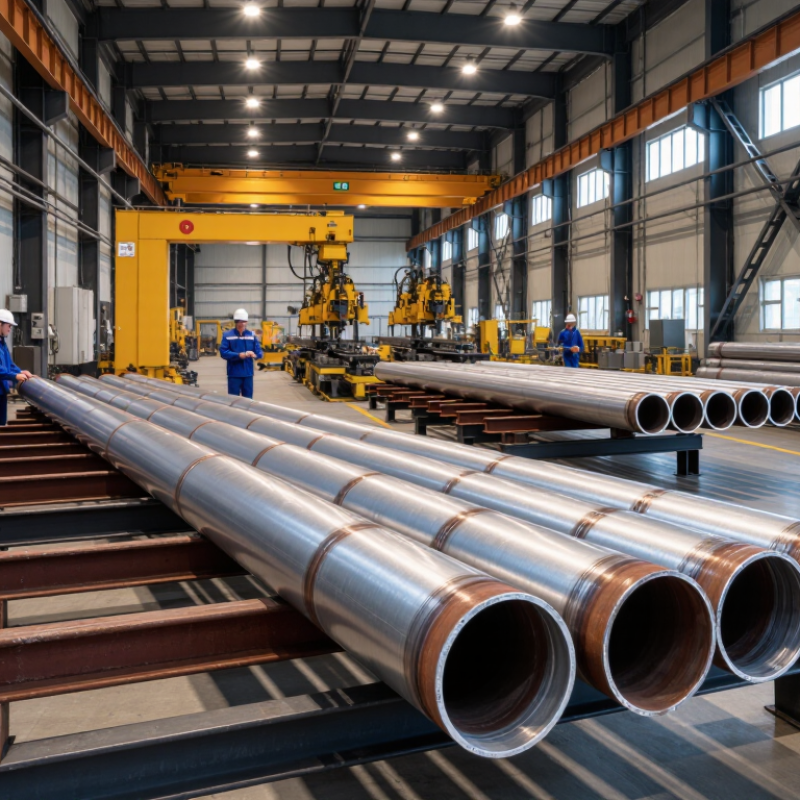
China’s Top 10 Overlay Welded Pipe Manufacturers: Selection Criteria and Scope
This ranking focuses on Chinese manufacturers producing overlay welded pipes for demanding industrial service. The scope includes pipes made with controlled welding processes, corrosion-resistant alloys, and documented dimensional inspection. It excludes simple distributors and workshops without stable production records. That boundary matters.
Selection begins with manufacturing experience. A credible supplier should explain welding parameters, substrate preparation, heat control, and repair procedures in practical terms. Inspectors should be able to review mill certificates, weld maps, batch numbers, and non-destructive testing reports. Ultrasonic testing, dye penetrant testing, and visual inspection can reveal different defects. No single test proves everything.
Technical capability also includes metallurgical control. Reviewers should examine dilution rates, overlay thickness, hardness, porosity control, and bonding quality. Factory visits offer useful evidence: clean welding bays, calibrated instruments, protected consumables, and clear material segregation. Project references help, but references can be selective. That weakness deserves attention. Delivery reliability, packaging, export experience, and response to nonconformities also influence the ranking. A low price may look attractive, yet inconsistent thickness can increase field repairs and downtime. The final scope therefore weighs verified production evidence more heavily than promotional claims, while recognizing that public information about some manufacturers remains incomplete.
A manufacturer-neutral evaluation framework for comparing Chinese overlay welded pipe suppliers without displaying company or brand information.
| No. | Selection Dimension | Technical Scope | Recommended Verification Evidence | Suggested Weight | Why It Matters |
|---|---|---|---|---|---|
| 01 | Overlay Welding Capability | GTAW, GMAW, SAW, or other qualified deposition processes for corrosion-resistant alloy overlays. | Qualified welding procedures, welder qualifications, deposition records, and repair procedures. | 15% | Controls dilution, bonding quality, chemistry, and resistance to service-related corrosion. |
| 02 | Base Pipe Manufacturing | Longitudinal or helical welded pipe, seamless pipe, and compatible pipe-end preparation. | Mill process descriptions, dimensional inspection reports, heat numbers, and traceability records. | 12% | A stable substrate is essential for overlay adhesion, roundness, and field installation. |
| 03 | Cladding Material Range | Stainless steels, nickel alloys, duplex and super-duplex grades, and other specified corrosion-resistant alloys. | Material certificates, positive material identification records, and applicable alloy specifications. | 12% | The alloy must match the process chemistry, temperature, pressure, and corrosion mechanism. |
| 04 | Dimensional and Thickness Control | Outside diameter, wall thickness, overlay thickness, ovality, straightness, and end tolerances. | Calibration certificates, dimensional maps, ultrasonic thickness reports, and inspection plans. | 10% | Accurate geometry supports fit-up, pressure design, welding, and non-destructive examination. |
| 05 | Non-Destructive Examination | Ultrasonic testing, radiographic testing, liquid penetrant testing, magnetic particle testing, or agreed alternatives. | NDE procedures, technician qualifications, acceptance criteria, and complete inspection reports. | 12% | Detects lack of fusion, cracks, inclusions, porosity, laminations, and other discontinuities. |
| 06 | Mechanical and Metallurgical Testing | Tensile, bend, hardness, shear or bond testing, macro-examination, and corrosion-related testing when specified. | Laboratory reports, test methods, sample identification, and independent inspection records. | 10% | Confirms structural integrity and the metallurgical suitability of the overlay system. |
| 07 | Standards and Quality Management | Application of contract-specified standards, quality plans, document control, and corrective-action systems. | Quality certificates, inspection and test plans, audit reports, and controlled manufacturing procedures. | 10% | Consistent documentation reduces technical, regulatory, and procurement risk. |
| 08 | Production Scale and Delivery Control | Available production lines, maximum workable dimensions, batch capacity, packaging, and export logistics. | Capacity statements, production schedules, inspection hold points, and shipment records. | 8% | Capacity and scheduling affect project timing, consistency, and supply continuity. |
| 09 | Engineering and Customization Support | Design review, corrosion assessment, welding consultation, drawings, repair methods, and project documentation. | Technical data sheets, approved drawings, calculation notes, and engineering response records. | 6% | Technical support helps convert process requirements into a manufacturable specification. |
| 10 | Commercial and After-Sales Reliability | Quotation clarity, warranty terms, claim handling, spare support, and responsiveness during inspection and installation. | Signed commercial terms, warranty documents, response records, and customer reference checks without publishing identities. | 5% | Reliable communication and accountability remain important throughout the project lifecycle. |
Reference Framework
The evaluation should be aligned with the project specification and applicable editions of recognized references such as API 5LD for CRA-clad or lined steel pipe, API 5L or ISO 3183 for line-pipe requirements where applicable, ASME Section IX for welding procedure and performance qualification, ASME B31.3 for process piping design, and ASTM or ISO material and testing standards specified by the purchaser.
Note: This manufacturer-neutral table presents selection criteria and evaluation scope only. Final ranking should be based on current, auditable supplier documentation, project-specific requirements, and third-party inspection results.
China’s top 10 overlay welded pipe manufacturers should be judged by measurable performance, not production volume alone. For corrosion-resistant alloy (CRA) pipe, the overlay layer commonly measures 3–5 mm. This range can support demanding service conditions, but it is not automatically suitable for every fluid or temperature.
Experienced buyers should verify welding procedures, dilution control, and surface uniformity. A stable layer should show consistent chemistry across the pipe length. Small variations can affect corrosion resistance.
Operators should also inspect bonding quality, hardness, wall thickness, and dimensional tolerance. These details often reveal more than a polished factory presentation.
API 5LD compliance remains a practical screening point for clad and lined pipe applications. Reliable manufacturers should provide traceable material certificates, qualified welding records, non-destructive testing reports, and independent inspection access. Testing may include ultrasonic examination, hydrostatic testing, and checks for interface separation. Documentation must match the actual heat numbers and pipe batches. That sounds basic.
However, a supplier can meet API 5LD requirements while still lacking strong project experience. Buyers should review previous service conditions, repair controls, and delivery consistency. A ranking may look precise, yet public data is often incomplete. The better question is whether the manufacturer can repeatedly produce a sound 3–5 mm CRA layer under controlled procedures.
A credible top-ten review of overlay welded pipe manufacturers should examine production evidence, not advertising claims. Large facilities may produce several thousand tonnes yearly, while specialized workshops focus on smaller, high-alloy orders. Buyers should request recent mill certificates, welding procedure records, and inspection reports. Capacity matters, but consistency matters more.
Manufacturers commonly use submerged arc welding, gas metal arc welding, or automated strip cladding. Strip cladding can create a smooth corrosion-resistant layer on carbon steel pipe. Flux-cored wire is useful for complex geometries and repair work. Common overlay materials include stainless steel, nickel alloys, duplex grades, and cobalt-based alloys. Each option suits different temperatures, chemicals, and flow conditions. Some suppliers use two welding layers. This improves coverage, but it can increase distortion and machining time.
Export profiles also reveal practical experience. Established producers may ship to energy, desalination, chemical processing, and offshore projects across Asia, Europe, the Middle East, and the Americas. Strong exporters understand wooden packing, moisture control, traceability labels, and destination documentation. Ask how they manage long-distance transport. Small details matter.
A careful profile should compare pipe diameters, wall thickness ranges, cladding thickness, heat-treatment capability, and ultrasonic testing coverage. Factory visits can expose gaps between stated and real capacity. Photos are not enough. Some manufacturers report impressive output, yet their subcontracting records remain unclear. That deserves closer review.
China’s top overlay welded pipe manufacturers should be compared through verified engineering evidence, not production claims. ASTM G48 testing can reveal pitting and crevice corrosion resistance in stainless steel or nickel alloy overlays. However, test temperature, exposure time, specimen preparation, and acceptance criteria must be recorded. A passing result means little when laboratories use different procedures.
ISO 21809-1 requires careful interpretation. It addresses three-layer polyethylene external coatings for buried or submerged pipelines, not the metallurgical quality of weld overlays. It can still matter when coated pipe includes an overlay layer beneath the external protection system. Inspectors should check surface cleanliness, coating adhesion, holiday detection, and repair records. Small defects grow.
ASME B31.3 supports process piping design, fabrication, examination, and testing. It does not rank manufacturers directly. A reliable supplier should connect B31.3 requirements with welding procedure qualifications, welder performance records, dilution control, hardness mapping, and non-destructive examination. In workshop inspections, uneven bead overlap and excessive heat input often deserve more attention than polished brochures. Some comparison tables remain incomplete because they omit repair rates and traceability after delivery. That weakness matters.
A practical assessment can score ten manufacturers by overlay chemistry, thickness tolerance, bond integrity, ASTM G48 evidence, ISO 21809-1 compatibility, and B31.3 documentation. Independent witnessing is preferable. Production speed is useful, but repeatable quality is more valuable.
China’s top 10 overlay welded pipe manufacturers should be assessed beyond website claims. Quality begins with controlled base-pipe chemistry, stable welding parameters, and consistent overlay thickness. Ask for mill certificates, welding procedure qualifications, and recent batch records. The documents should match the actual pipe heat numbers.
Testing reveals practical reliability. Request ultrasonic testing, radiographic testing, hydrostatic testing, hardness checks, and metallographic examination where required. For corrosive service, verify alloy composition through positive material identification. Confirm whether inspections follow the project specification, not only a general standard. Certifications such as ISO systems or product approvals support credibility, but they do not replace independent inspection. Small gaps matter. A certificate may not prove every delivered batch.
Lead time depends on pipe diameter, overlay alloy, testing scope, and production capacity. A 24-inch pipe with extensive third-party inspection may need several weeks longer than a standard order. Confirm drawing approval dates, welding trials, inspection hold points, packing details, and shipping schedules in writing. Project selection should match service conditions, pressure, temperature, corrosion risk, and installation method. I would not select the lowest quotation without comparing rejection rates and corrective-action records. That approach is imperfect, but price alone often hides expensive delays. A factory sample can look excellent, while production consistency still needs verification.
To learn more about any of the products and services provided by Abbott Ball Company, Inc., simply complete the form below.