Buying aisi 304 stainless steel can seem straightforward, yet small errors often become expensive problems. A polished sheet may look excellent under warehouse lights. Its actual composition, thickness, and surface condition still require verification. This guide introduces ten practical tips for making a more reliable purchase.
Experienced buyers should examine more than the grade name. Ask for a material test certificate, heat number, and clear product specifications. Confirm chromium and nickel content through reputable documentation when the application demands it. Check thickness tolerance, dimensions, finish, edge quality, and packaging before approving an order. AISI 304 performs well in many indoor, food-processing, architectural, and general industrial environments. However, it is not the ideal choice for every corrosive setting. Chlorides, coastal exposure, and stagnant moisture may require a different grade.
Details matter.
Supplier reliability deserves equal attention. Review production experience, inspection procedures, traceability, and customer feedback. Request samples when appearance or forming performance matters. A small sample can reveal scratches, uneven brushing, burrs, or inconsistent color. Compare quotations carefully, because a lower price may hide thinner material, weaker documentation, or poor handling. This article also considers delivery terms, certification needs, fabrication compatibility, and after-sales support. The recommendations are practical, but no checklist replaces engineering judgment. I have seen buyers focus heavily on price and regret ignoring the final service environment. Careful questions may slow the purchase slightly. They can prevent rejected batches, premature corrosion, and costly rework.
AISI 304 stainless steel is an austenitic chromium-nickel alloy. It usually contains about 18% chromium and 8–10.5% nickel. This chemistry forms a passive surface film that slows rust in ordinary indoor and outdoor conditions. It is generally nonmagnetic when annealed. Cold working can make it slightly magnetic. That detail matters during inspection. The grade also welds well and forms easily into sinks, tubing, panels, and precision parts.
Common applications include food-processing tables, kitchen sinks, beverage tanks, medical equipment, architectural trim, and household appliances. Its smooth surface is easy to clean, while its toughness supports repeated washing and daily handling. However, “all-purpose stainless” is an imperfect description. Not always. Salt spray, bleach residue, and stagnant water can cause pitting, especially around welds or crevices. For coastal or chemical service, a more resistant grade may be wiser. When buying, check the material certificate, thickness, surface finish, and weld condition. Check the welds. A practical decision matches the grade to the actual environment, not simply the lowest price. I would question unclear claims about “304 quality”; composition and traceability should be documented. Small omissions can become expensive repairs.
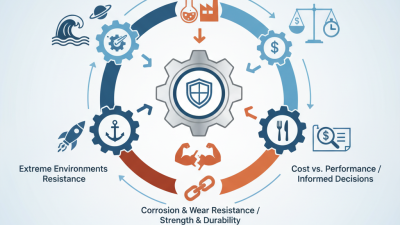
Buying AISI 304 stainless steel starts with the correct specification, not a polished surface. ASTM A240/A240M commonly defines 304 sheet and plate with 18–20% chromium, 8–10.5% nickel, and carbon not exceeding 0.07%. Verify the exact edition and product form. Tube, bar, and fastener standards may differ. EN 10088-2 may also apply in European supply chains. Do not treat “304” as a complete purchasing description.
Ask for a material test certificate linked to the heat number on the bundle. A reliable EN 10204 type 3.1 certificate should show chemical results, mechanical properties, dimensions, and inspection authorization. Check whether the certificate covers the actual batch. A generic PDF is weak evidence. Portable X-ray fluorescence can confirm chromium and nickel quickly, but it cannot measure carbon accurately. For critical orders, use an independent laboratory accredited to ISO/IEC 17025.
Scale makes verification important. The International Stainless Steel Forum reported approximately 58.4 million tonnes of global crude stainless steel production in 2023. Large output does not guarantee consistent quality. Confirm mill origin, surface finish, thickness tolerance, and heat treatment records. ISO 9001 certification supports process control, but it does not certify every sheet. I have seen buyers confuse the two. That mistake is expensive. Request samples, compare them with the certificate, and record the inspection before accepting delivery.
| Tip | What to Check | Typical AISI 304 Requirement or Reference Data | Documents or Verification to Request | Main Risk if Missed |
|---|---|---|---|---|
| 1 | Confirm the grade identity | Specify AISI 304 and cross-reference the material designation: UNS S30400 EN 1.4301 X5CrNi18-10. Do not treat 304, 304L, 316, and 321 as interchangeable grades. | Purchase specification, heat number, material certificate, and positive material identification report. | Wrong alloy selection |
| 2 | Match the product standard to the product form | Use a product-specific standard rather than a general grade description: ASTM A240 for plate, sheet, and strip; ASTM A276 for bars and shapes; ASTM A312 for seamless or welded pipe; ASTM A269 for general-purpose seamless or welded tubing; and ASTM A403 for wrought stainless steel piping fittings. | Quotation and order confirmation showing the exact product standard, dimensions, manufacturing route, and delivery condition. | Nonconforming product |
| 3 | Review chemical composition | Common ASTM limits for 304 include carbon maximum 0.08%, chromium 18.0–20.0%, nickel 8.0–10.5%, manganese maximum 2.00%, silicon maximum 1.00%, phosphorus maximum 0.045%, and sulfur maximum 0.030%. The applicable product standard controls the final limits. | Heat analysis and, where required, product analysis listed on the material test certificate. | Reduced corrosion resistance |
| 4 | Distinguish 304 from 304L | AISI 304 normally permits carbon up to 0.08%, while 304L permits carbon up to 0.030%. Select 304L when lower carbon is required for welded fabrication and reduced risk of sensitization in the heat-affected zone. | Certified carbon value, grade designation, welding procedure requirements, and any project-specific low-carbon requirement. | Weld-related corrosion |
| 5 | Check mechanical properties | For annealed 304 sheet and plate under commonly used ASTM requirements, typical minimum values include tensile strength of 515 MPa, yield strength of 205 MPa, and elongation of 40% in 50 mm. Values vary by product form, thickness, and standard. | Tensile test results, yield strength, elongation, hardness where specified, test direction, and applicable standard edition. | Unexpected deformation or failure |
| 6 | Specify condition and heat treatment | State whether the material must be annealed, solution treated, cold worked, or supplied in another condition. AISI 304 cannot be hardened by conventional heat treatment; strength can increase through cold working. | Delivery-condition statement, heat-treatment record when applicable, hardness data, and cold-reduction information if required. | Incorrect strength or formability |
| 7 | Control dimensions and tolerances | Define thickness, outside diameter, wall thickness, width, length, flatness, straightness, and permitted tolerances. Tolerances depend on the product standard, nominal size, and manufacturing process. | Approved drawing, dimensional inspection report, calibration records, and sampling plan. | Assembly or fabrication problems |
| 8 | Specify surface finish and cleanliness | For sheet and plate, identify the required finish, such as 2B, No. 1, or polished finish where applicable. Define requirements for pickling, passivation, descaling, burr removal, oil, embedded iron, scratches, and visible defects. | Surface-finish code, approved sample, visual inspection report, and passivation or cleanliness certificate when required. | Appearance or corrosion defects |
| 9 | Request the correct material certification | Require a traceable material test certificate with the heat number, grade, standard, chemical results, mechanical results, dimensions, and delivery condition. EN 10204 Type 3.1 is commonly used for manufacturer-certified inspection documents; Type 3.2 adds validation by an independent inspector or purchaser-appointed representative. | Signed EN 10204 3.1 or 3.2 certificate, heat-number traceability, certificate of conformity, and any required inspection release note. | Unverifiable material origin |
| 10 | Verify before acceptance and shipment | Compare markings, quantity, dimensions, grade, heat number, surface condition, packaging, and documents against the purchase order. Use positive material identification when alloy mix-up is a critical risk. Additional tests, such as corrosion or intergranular corrosion testing, should be specified only when required by the application or governing standard. | Incoming inspection checklist, PMI report, dimensional report, photographic records, packing list, and nonconformance procedure. | Rejected or unsafe delivery |
Compare Thickness, Surface Finish, Dimensions, and Fabrication Quality
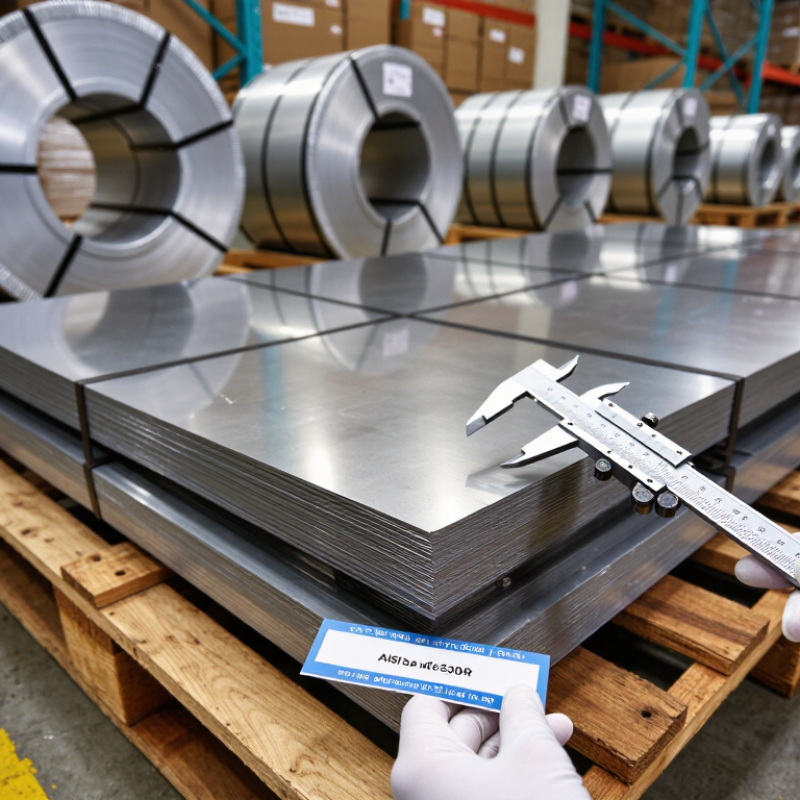
AISI 304 stainless steel can look similar across suppliers, yet performance varies greatly. Check the stated thickness against your drawing and required load. Request actual thickness measurements from several points. Small differences may affect bending, welding, and final assembly. Confirm the permitted tolerance, not just the nominal size. Review sheet length, width, flatness, and squareness before payment. Oversized material may seem harmless, but cutting waste increases quickly. Measure twice.
Surface finish deserves careful attention. Specify whether you need 2B, brushed, polished, or another finish. Ask for sample photos under comparable lighting. A glossy surface can hide scratches, dents, or uneven polishing. Inspect protective film, edges, and visible handling marks. In practical shop inspections, consistent grain direction often matters more than brightness. That judgment is not always obvious. Discuss appearance standards with the fabricator before production begins.
Fabrication quality includes cutting accuracy, hole position, bending radius, and weld appearance. Check that tools are clean and suitable for stainless steel. Carbon-steel contamination can create stains later. Ask how weld discoloration will be removed and whether the surface will be passivated when appropriate. Request dimensional inspection records and a material certificate referencing recognized specifications, such as ASTM A240 or EN 10088. One detail is easy to miss: confirm the actual 304 grade, rather than accepting “stainless steel” on an invoice. I would also inspect a trial piece before approving a large order. Mistakes become expensive after fabrication.
Buying AISI 304 starts with supplier verification, not a low headline price. Ask for a current mill test certificate, heat number, chemical analysis, tensile results, and surface grade. Verify the certificate against the coil or sheet marking. World Stainless reported 58.4 million tonnes of stainless crude steel production in 2023. That scale creates options, but not equal traceability. Request sample photos, inspection procedures, export experience, and references from comparable orders. A video call can expose weak packaging or vague answers. It is not perfect evidence.
Build pricing from the same specification. Compare thickness tolerance, finish, width, cutting, packing, freight, duties, and payment terms. Nickel matters because 304 contains significant nickel. The World Bank Pink Sheet recorded nickel at about $21,521 per metric ton in 2023, after $25,834 in 2022. Alloy surcharges may therefore change monthly. Ask whether the quote is fixed, indexed, or valid for seven days. One overlooked detail can erase the apparent savings. I have made that mistake.
Lead time should show each stage: order confirmation, material allocation, production, inspection, and dispatch. Request a realistic shipping window, not “fast delivery.” For standard sheets, 15–30 days may be possible; custom slitting or small lots can take longer. Minimum order quantity deserves equal attention. Some mills quote one coil, while service centers accept a few sheets but charge cutting fees. Ask about partial delivery and stock availability. Keep written tolerances and remedies for delays. Supplier claims need checking against documents and actual performance.
Buying AISI 304 stainless steel should begin with a physical sample, not a polished promise. Ask for a cut piece from the same production batch. Check its surface under bright, angled light. Look for pits, rolling marks, embedded iron, and uneven polishing. Measure thickness at several points with a calibrated gauge. Small variations can affect fabrication and service life. A sample may look excellent while the delivered coil differs. I have seen this happen.
Confirm the grade with traceable mill documentation and, where risk is high, independent material verification. Portable X-ray fluorescence can screen chromium and nickel content, but it cannot prove every quality feature. Request test records for chemical composition, tensile strength, and heat treatment. Check whether the report matches the heat number stamped on the sample. Missing traceability is a warning. Do not ignore it.
Corrosion resistance depends on the environment, not only the word 304. Expose a representative sample to relevant moisture, salts, cleaners, or process chemicals. A controlled laboratory test is better than a quick splash test. Inspect edges, welds, and crevices separately, because they often fail before flat surfaces. Check the edges. Ask how the material was pickled, passivated, stored, and protected from carbon steel dust. I would also question unusually low prices. Sometimes the saving hides a wrong grade, poor handling, or incomplete testing. My own checks are not flawless, so I record photos, batch numbers, and test conditions for later review.
To learn more about any of the products and services provided by Abbott Ball Company, Inc., simply complete the form below.