
In pumps, valve assemblies, and laboratory equipment, small material choices can affect uptime, maintenance, and product quality. That is one reason engineers consider PTFE rod and sheet for demanding industrial components. The material is valued for chemical resistance, low friction, and useful performance across a broad temperature range. But those qualities do not make every design simple. Details matter.
Ptfe Rod Sheet can be machined into seals, bushings, guides, liners, and insulating parts, depending on the grade and operating conditions. A rod may suit a turned component, while sheet can provide a flat lining or gasket blank. For example, a chemical transfer pump may need a low-friction bushing, while a storage tank may call for a sheet liner. The right choice depends on concentration, temperature, pressure, and movement. In practice, designers still need to check load, creep, dimensional tolerance, and chemical exposure. A part that looks right on a drawing may deform under sustained pressure. That deserves attention. Selection should account for installation, surface finish, and the supplier’s technical data, rather than relying on a generic label. This guide examines why PTFE rod and sheet remain useful, where their limits appear, and what questions help buyers choose responsibly. No material is perfect. Thoughtful selection begins with actual service conditions, not a broad claim of universal resistance.
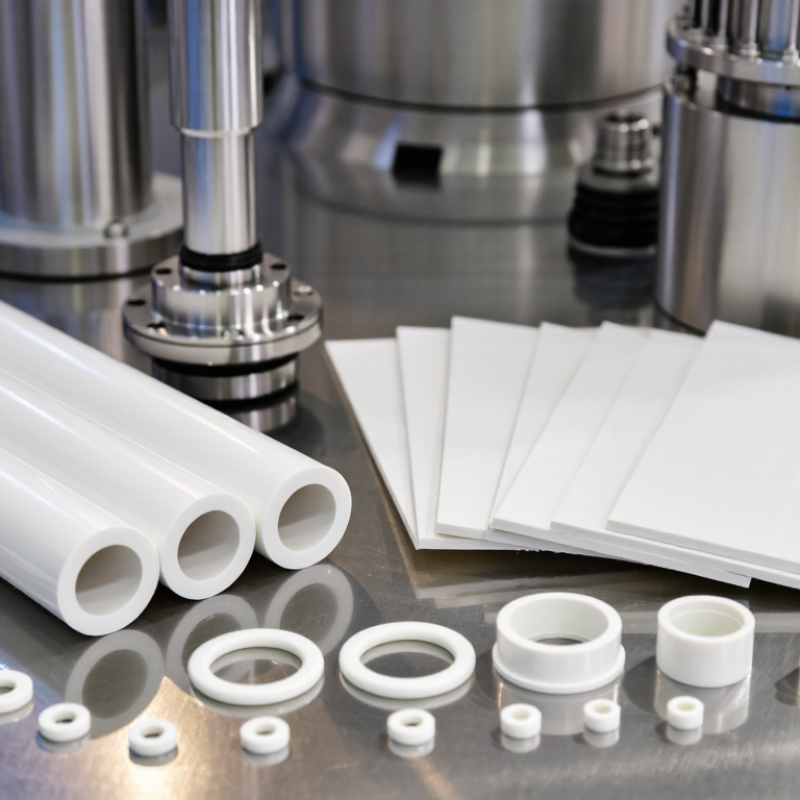
PTFE rod and sheet are solid, semi-finished forms of polytetrafluoroethylene, a fluoropolymer valued for low friction and resistance to many chemicals. A rod has a round cross-section, while a sheet is flat stock supplied in different thicknesses. Both can be cut or machined into components; they are not necessarily ready to install as supplied.
In industrial settings, rod stock is often machined into bushings, rollers, or small valve parts. Sheet can become liners, seals, or sliding surfaces. PTFE’s properties can help parts move smoothly and resist corrosive exposure, but performance depends on temperature, load, fit, and the specific grade. Not quite that simple. Under sustained pressure, PTFE can deform over time, so a low-friction material is not automatically the right choice for every bearing or seal. A tidy specification can still miss how the part will behave in real service.
Tips: Match the stock shape to the finished component and machining plan. Check operating temperature, chemical contact, and compressive load with a qualified materials supplier. If dimensions are critical, allow for machining tolerances and inspect the finished part; small fit differences can matter.
| Dimension | PTFE Rod | PTFE Sheet | Industrial Relevance |
|---|---|---|---|
| What it is | Solid cylindrical semi-finished stock made from polytetrafluoroethylene (PTFE). | Flat, solid semi-finished stock made from polytetrafluoroethylene (PTFE). | Both forms are commonly cut or machined into components; they are stock shapes, not finished parts. |
| Typical manufacturing routes | Often produced by extrusion or molding, depending on diameter, grade, and process. | Often produced by molding or skiving, depending on thickness and product specification. | Manufacturing route can affect dimensions and properties, so confirm the material specification for the intended use. |
| Chemical resistance | PTFE resists attack by many industrial chemicals, including many acids and solvents. Compatibility depends on the chemical, concentration, temperature, and exposure conditions. | Useful for components in chemical-handling equipment. Compatibility should be checked for the actual service environment. | |
| Temperature capability | Unfilled PTFE is commonly used across a broad temperature range, often cited as approximately −200°C to +260°C; limits vary by grade, load, and application. | Check continuous and intermittent operating temperatures, as well as mechanical loading and installation conditions. | |
| Friction and release | PTFE has a low coefficient of friction and non-stick characteristics. Actual performance varies with surface finish, counterface, load, speed, and test method. | Can be useful for sliding interfaces, guides, liners, and release surfaces. It is not automatically suitable for every wear application. | |
| Electrical properties | PTFE is a strong electrical insulator with low dielectric loss over a broad range of conditions. | May be selected for insulating parts and electrical components, subject to voltage, frequency, temperature, and design requirements. | |
| Typical density | Unfilled PTFE commonly has a density of about 2.1–2.3 g/cm³. Filled grades can have different values. | Use the supplier’s grade-specific data when calculating component mass or checking material specifications. | |
| Mechanical considerations | PTFE is relatively soft compared with many engineering plastics and can deform or creep under sustained load. Fillers may improve selected properties but can change others. | Consider load, dimensional tolerances, support, creep, and whether a filled PTFE grade is required. | |
| Common machined parts | Often used as a starting shape for bushings, spacers, rollers, valve components, and insulators. | Often used as a starting shape for gaskets, seals, liners, wear pads, and insulation parts. | Choose the form that best matches the component geometry and machining or fabrication plan. |
| Stock size availability | Available in a range of diameters and lengths, which varies by producer, grade, and manufacturing method. | Available in a range of thicknesses and sheet sizes, which varies by producer, grade, and manufacturing method. | Confirm available dimensions, tolerances, and grade before designing a part around a stock size. |
Note: Property ranges are representative of unfilled PTFE and are provided for general comparison, not as design guarantees. Verify grade-specific data, test methods, chemical compatibility, and operating conditions before use.