What Is Petroleum Coke Composition and How Is It Tested?
Petroleum Coke Composition determines how this carbon-rich material behaves during storage, handling, and industrial use. It commonly includes fixed carbon, sulfur, volatile matter, moisture, ash, and trace metals. These components can change with crude oil origin and refining conditions. Even samples from one shipment may differ.
Testing starts with representative sampling. A technician may collect increments from several locations, then combine and reduce them carefully. Poor sampling can distort every later result. That limitation matters.
Laboratories commonly measure moisture and volatile matter through controlled heating. They determine ash by removing combustible material under specified conditions. Sulfur analysis may use combustion-based instruments or other validated techniques. X-ray fluorescence can help assess elements such as nickel and vanadium. Standardized methods, calibrated equipment, and documented quality controls improve confidence.
Numbers need context.
A strong evaluation compares test results with the selected method, sample preparation, and reporting basis. Dry-basis and as-received values are not interchangeable. Experienced analysts also review repeatability, detection limits, and unusual results before accepting a report. Accredited laboratories can provide stronger assurance, but accreditation does not remove every possible error.
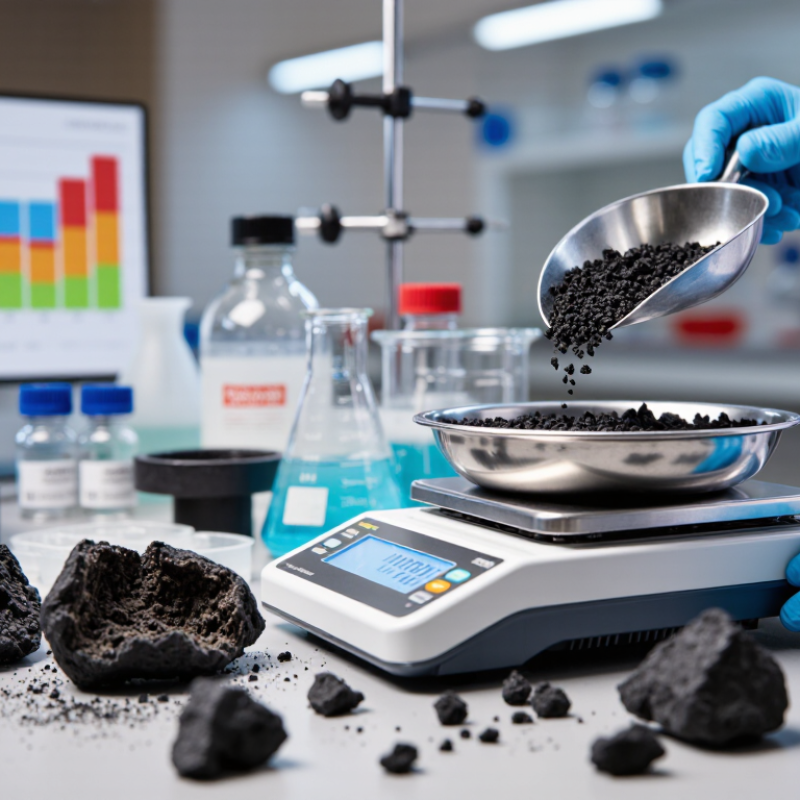
This guide explains Petroleum Coke Composition and the practical methods used to test it. It focuses on evidence rather than assumptions. Readers will see how laboratory procedures connect with real material conditions, including dusty stockpiles, moisture variation, and visible differences in particle size. Some results may still require professional interpretation. That is not a weakness in the process. It is an honest reminder that reliable testing depends on representative samples, suitable standards, and careful judgment.
Petroleum Coke Defined: 85–95 wt% Carbon, Origin, and Product Grades
Petroleum coke is a carbon-rich solid created during delayed coking in oil refining. Its carbon content commonly ranges from 85–95 wt%, depending on grade and reporting basis. “Wt%” means weight percent, not volume percent. Results also change when laboratories report moisture-free or as-received material. This distinction matters.
Green petroleum coke usually contains residual volatile matter, sulfur, ash, moisture, and trace metals such as nickel and vanadium. Fuel-grade material often has higher sulfur and metals. Anode-grade coke generally requires lower impurities and more consistent structure. Calcined coke is heat-treated to remove volatiles and improve electrical performance. Product grades are therefore defined by more than carbon content alone.
Sampling matters. A technician should collect increments from different points, then combine and reduce them carefully. Poor sampling can produce a precise result from an unrepresentative sample. In the laboratory, proximate analysis measures moisture, volatile matter, ash, and fixed carbon. Ultimate analysis measures carbon, hydrogen, nitrogen, sulfur, and oxygen. X-ray fluorescence can examine sulfur and metallic elements, while inductively coupled plasma testing provides detailed trace-metal data. Bulk density, particle size, and real density may also be checked for industrial use. Results can drift. Different preparation methods, instruments, and reporting bases may explain unexpected differences. A careful test report should state the method, sample condition, detection limits, and basis clearly.
Petroleum Coke Composition and Testing
Petroleum coke typically contains about 85–95 wt% total carbon. The chart shows indicative dry-basis composition ranges for fuel-grade and anode-grade green petroleum coke. These parameters are independent quality indicators and should not be added together as a single mass balance. Carbon is commonly measured by elemental analysis, volatile matter and ash by proximate analysis, and sulfur by combustion-based sulfur analysis.
Grade Metrics: Fuel-Grade, Anode-Grade, Calorific Value, Vanadium, and Nickel
What Is Petroleum Coke Composition and How Is It Tested?
Petroleum coke composition determines whether it fits fuel or anode applications. Fuel-grade coke usually accepts higher sulfur and metal levels, while anode-grade coke needs tighter control. Commercial green coke commonly delivers about 7,500–8,500 kcal/kg gross calorific value, but moisture can reduce usable heat. The U.S. Energy Information Administration reports petroleum coke energy content near 30 million Btu per short ton, depending on quality and measurement basis.
Sulfur remains a major screening metric. High sulfur may increase emissions-control requirements and limit furnace choices. Vanadium and nickel also matter, especially in combustion systems and aluminum anode production. Typical anode-grade targets may place vanadium below 300 ppm and nickel below 100 ppm, although contract limits vary. The U.S. Geological Survey’s Mineral Commodity Summaries 2024 highlights petroleum coke as a refinery byproduct with highly variable sulfur and metal content. That variability is easy to underestimate.
Tips: Test a representative composite sample, not only the surface layer. Laboratories commonly use ASTM D4239 for sulfur and ASTM D5865 for gross calorific value. Ask for ash, volatile matter, moisture, vanadium, and nickel results in the same report. Check the basis carefully: as-received and dry-basis values are not interchangeable. One overlooked detail can change the commercial grade. My practical view is cautious: a single certificate rarely tells the whole story, particularly when refinery feedstock changes.
Sampling and Preparation: ASTM D6969 and Representative Test Portions
Petroleum coke composition depends heavily on feedstock and process severity. Sampling must therefore prevent bias before testing begins. ASTM D6969 provides a structured approach for preparing coke samples and producing representative test portions. A shovelful from the surface is not enough. Fine particles often collect near the bottom, while larger, denser pieces remain near the edges.
In practical laboratory work, increments should come from different locations, depths, and discharge times. The combined sample is mixed, reduced, crushed, and divided without losing fines. ASTM D6969 emphasizes contamination control and suitable particle-size reduction. These steps support reliable analysis for sulfur, ash, moisture, volatile matter, and metals. The U.S. Energy Information Administration’s Petroleum Supply Annual reports roughly 40 million short tons of U.S. petroleum coke production in recent years. That scale makes sampling errors commercially significant. A tiny bias can affect an entire shipment assessment.
Tips: Use clean tools, sealed containers, and documented sample weights. Record moisture conditions immediately. Do not assume visible uniformity means chemical uniformity. Duplicate preparations can reveal hidden variation, although they also consume time and material. In my view, the weakest point is often not the instrument. It is the rushed reduction step. One overlooked handful may change the reported result.
Laboratory Testing: ASTM D4292, D5184, D5709, and D6374 Methods
Petroleum coke is mainly fixed carbon, with variable sulfur, volatile matter, moisture, ash, nickel, vanadium, iron, and silicon. Its composition changes with crude feedstock and refinery operating conditions. The U.S. Energy Information Administration’s Petroleum Supply Monthly reports continued U.S. petroleum coke production above 70 million barrels in several recent months. That scale makes consistent laboratory control essential.
ASTM D4292 supports sulfur measurement, commonly using X-ray fluorescence after careful sample preparation. ASTM D5184 measures aluminum and silicon after ashing, fusion, and atomic absorption analysis. These elements can affect ash behavior and equipment performance. ASTM D5709 determines trace metals, including nickel and vanadium, by atomic absorption. ASTM D6374 uses inductively coupled plasma atomic emission spectrometry for broader trace-metal screening. The U.S. Geological Survey’s Mineral Commodity Summaries 2024 also identifies petroleum coke quality as dependent on refinery feedstock and processing conditions.
A representative sample matters most. Technicians should dry, crush, and homogenize the coke before testing. Large particles can hide metal-rich ash. Moisture can also distort reported concentrations. The result is not always as clean as expected. Different preparation choices may produce different values. Laboratories should record sieve size, drying temperature, calibration materials, detection limits, and quality-control results with every report. Current ASTM editions must be checked before contractual or regulatory use.