
Copper Alloy Winding Wire is an engineered conductor used in motors, transformers, generators, and other electromagnetic equipment. It combines copper’s excellent conductivity with selected alloying elements. These additions can improve strength, heat resistance, flexibility, or resistance to mechanical wear. The result is not simply ordinary copper wire with a different label. Its performance depends on alloy composition, wire diameter, insulation quality, and manufacturing accuracy.
Small details matter. A winding wire may pass through narrow slots, around sharp corners, or across thousands of repeated bends. In practical production, technicians inspect its surface for scratches, measure electrical resistance, and check insulation thickness. Engineers also evaluate elongation, tensile strength, thermal endurance, and resistance to vibration. Applicable industry standards can support consistent testing and traceability. However, a certificate alone does not guarantee suitable performance. The wire must match the equipment’s current load, operating temperature, winding method, and service environment.
Copper Alloy Winding Wire offers useful design possibilities. It may provide stronger coils where pure copper deforms too easily. It can also support compact winding structures and more stable operation under mechanical stress. Yet higher strength may involve reduced conductivity or greater material cost. That trade-off deserves careful review. A rushed selection can create excess heating, difficult winding, or shortened insulation life. Even experienced engineers can misjudge the balance. For this reason, reliable decisions combine supplier data, laboratory results, production experience, and application-specific testing. The right alloy is rarely universal. It is chosen for the real conditions inside the finished machine.
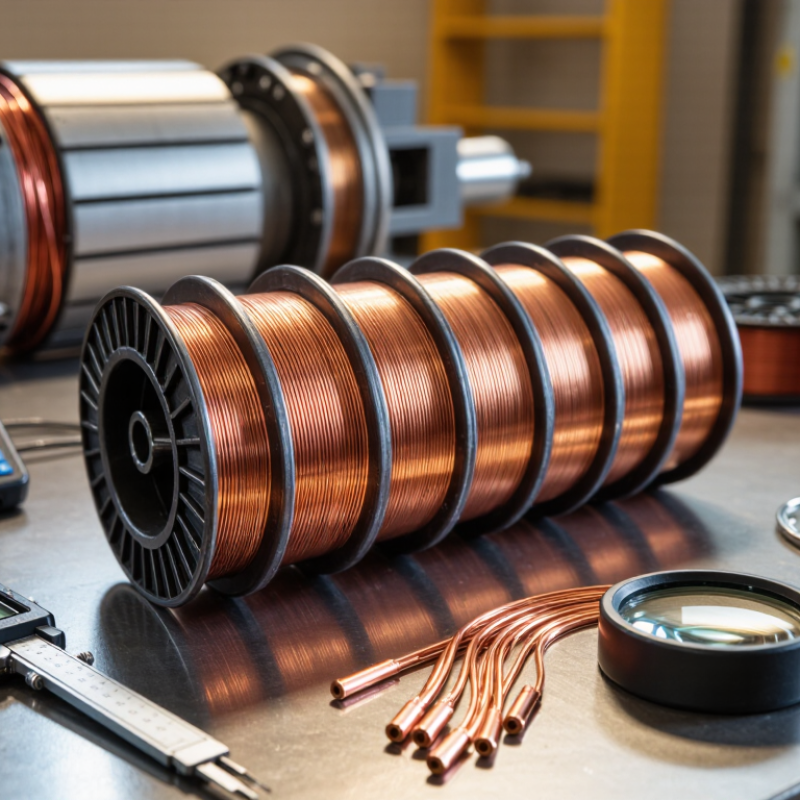
What Is Copper Alloy Winding Wire?
Definition and Basic Structure of Copper Alloy Winding Wire
Copper alloy winding wire is an insulated conductor used to form coils in motors, transformers, relays, and sensors. Its core is mainly copper, combined with small amounts of other metals. These additions can improve strength, heat resistance, flexibility, or resistance to softening. They can also reduce electrical conductivity. That trade-off matters.
The structure is layered. At the center is the copper alloy conductor, usually round, rectangular, or square. Around it is a thin enamel insulation film. Some designs include bonding layers, glass coverings, paper, or protective overcoats. The outer surface must resist winding tension and contact with nearby turns. It is not merely colored metal.
During production, engineers control alloy composition, conductor size, surface cleanliness, and insulation thickness. A wire may look smooth, yet one tiny scratch can create a weak electrical point. Technicians commonly check diameter, resistance, insulation adhesion, flexibility, and surface defects. I have found that temperature changes affect handling; cold wire can feel less forgiving during tight bends. This detail is easy to miss.
The alloy core carries current, while the insulation separates neighboring turns electrically. Thousands of turns may fit inside a narrow slot. Small dimensional errors can reduce space efficiency or restrict heat removal. A practical mistake is choosing high strength without checking conductivity, temperature class, and winding tension together.
Copper alloy winding wire uses copper blended with small amounts of elements such as silver, chromium, zirconium, or tin. These additions adjust the conductor’s behavior without removing copper’s strong electrical performance. The result is a wire designed for demanding coils, motors, transformers, and generators.
Pure copper conducts electricity extremely well, but it can soften under repeated heating. Copper-silver alloys improve strength and retain useful conductivity at elevated temperatures. Copper-chromium and copper-zirconium alloys can resist softening during thermal cycling. Tin-bearing alloys may offer better wear resistance, though their conductivity can decrease.
A winding engineer checks conductivity, tensile strength, elongation, and thermal stability together. For example, a tightly formed motor coil may experience vibration, sharp bends, and temperatures above normal room conditions. A stronger conductor can reduce stretching during winding. However, excessive strength may make forming more difficult. Insulation compatibility also matters, especially when enamel must survive heat, pressure, and repeated movement.
In practical production, resistance measurements should be matched with dimensional checks. Small changes in diameter can affect current density and coil temperature. Testing after bending is valuable because a wire can pass a straight-line test yet fail after forming. This point is sometimes overlooked. Alloy selection should follow the equipment’s operating temperature, mechanical stress, and available winding process, not conductivity alone.
What Is Copper Alloy Winding Wire?
How Copper Alloy Winding Wire Is Manufactured
Copper alloy winding wire begins with carefully selected copper and small amounts of alloying elements. These additions can improve strength, heat resistance, flexibility, or resistance to mechanical fatigue. The exact balance matters because higher strength may reduce electrical conductivity.
Production starts in a controlled melting furnace. Technicians monitor temperature, chemical composition, and oxygen levels during this stage. The molten alloy is cast into a bar or rod. It is then hot-rolled to improve its shape and internal structure.
The wire passes through several drawing dies. Each die reduces its diameter and increases its length. Lubrication limits friction and helps prevent surface damage. Intermediate annealing softens the metal after repeated drawing. This step is easy to underestimate. Without it, the wire may crack or lose flexibility.
After reaching the required size, the conductor receives an insulating enamel coating. The coating is applied in thin, repeated layers and cured with controlled heat. Operators check coating thickness, adhesion, pinholes, and electrical breakdown strength. They also measure resistance, elongation, and tensile performance.
Manufacturing is precise, but never completely effortless. A tiny surface mark can affect insulation quality later. Excessive tension may create hidden weaknesses. For this reason, reliable production combines calibrated equipment, documented inspections, and experienced judgment. Testing samples from different production stages also helps reveal problems before the wire enters a motor or transformer.
Copper alloy winding wire balances electrical, thermal, and mechanical performance. Pure copper offers excellent conductivity, but alloying adds strength, wear resistance, and better resistance to deformation. The trade-off is real. Higher alloy content usually reduces conductivity.
IEC 60028 defines annealed copper as 100% IACS, equal to approximately 58 MS/m at 20°C. The International Copper Association reports copper thermal conductivity near 398 W/m·K at room temperature. Copper alloy wire performs below this level, depending on its composition and temper. Lower conductivity increases I²R losses and can raise winding temperature. A practical design must check resistance at operating temperature, not only at 20°C. NEMA MG 1 guidance also links motor performance with temperature rise, insulation life, and loading conditions. Mechanical strength matters during coil insertion, bending, vibration, and short-circuit stress. A stronger alloy may survive manufacturing better, yet reduce efficiency slightly. This compromise is easy to underestimate.
Tips: Compare conductivity, tensile strength, elongation, and softening temperature together. Confirm the exact alloy and temper from test certificates. Use thermal imaging during prototype testing. Calculations can look correct, but real coils may reveal tighter bends, uneven impregnation, or unexpected hot spots. Reported values also vary with gauge, processing, and measurement method.
What Is Copper Alloy Winding Wire?
Copper alloy winding wire combines copper with small amounts of elements such as silver, tin, or chromium. This adjustment can improve tensile strength, heat resistance, fatigue performance, or resistance to vibration. Electrical conductivity may decrease slightly. That trade-off matters.
Common Applications and Selection Considerations
Engineers use this wire in motors, transformers, generators, relays, and compact electromagnetic actuators. It suits equipment exposed to repeated movement, high temperature, or mechanical stress. In a motor winding, stronger wire can reduce damage during insertion and forming. In a transformer, conductivity and insulation quality usually receive greater attention.
Selection begins with the operating conditions. Check current, voltage, frequency, winding temperature, and available space. Wire diameter controls resistance and heat generation. Enamel thickness affects insulation reliability and slot filling. A harsh environment may require stronger insulation and better corrosion resistance. A small dimensional error can still affect winding performance.
Standards matter. Request test data for conductivity, tensile strength, elongation, and insulation breakdown voltage. Confirm compatibility with varnish, soldering, and the winding process. Technicians should also consider bending radius and springback during installation. Too much strength can make forming difficult. Too much conductivity loss can increase heat. This balance is easy to underestimate. A practical trial winding often reveals problems that a datasheet misses.
| Data Dimension | Typical Material or Range | Key Characteristics | Common Applications | Selection Considerations |
|---|---|---|---|---|
| Definition | Insulated round, rectangular, or shaped conductor made from copper or a copper alloy | Combines electrical conductivity with an enamel, film, or other insulation system so the conductor can be wound into coils | Motors, generators, transformers, inductors, relays, solenoids, and other electromagnetic devices | Specify conductor alloy, cross-sectional shape, insulation system, thermal class, dimensions, and applicable test requirements |
| Electrolytic tough-pitch copper (Cu-ETP) | Approximately 100% IACS conductivity; commonly supplied in annealed or drawn conditions | Excellent conductivity, good ductility, good availability, and cost-effective processing | General-purpose motor windings, transformer windings, generator coils, and appliance motors | Use when conductivity and formability are the main priorities and the operating environment does not require oxygen-free copper |
| Oxygen-free copper (Cu-OF) | Typically about 100% IACS conductivity, depending on processing and temper | Very low oxygen content; suitable for applications where heating, vacuum processing, or material purity is important | High-reliability coils, vacuum-related equipment, specialized transformers, and precision electromagnetic components | Consider when brazing, vacuum exposure, or elevated-temperature processing could make oxygen-related embrittlement undesirable |
| Silver-bearing copper (CuAg) | Common grades provide roughly 97–101% IACS conductivity, depending on silver content and condition | Better resistance to softening and creep at elevated temperature than commercially pure copper, while retaining high conductivity | High-temperature motor and generator windings, traction equipment, and demanding electrical machines | Choose when the winding must retain mechanical strength during repeated thermal cycling or sustained elevated-temperature operation |
| Chromium-zirconium copper (CuCrZr) | Common conductivity range is approximately 75–85% IACS, depending on composition and heat treatment | High strength, good softening resistance, and improved resistance to deformation compared with pure copper | High-current electrical machines, compact windings, welding equipment, and applications exposed to mechanical or thermal stress | Balance the lower conductivity against the need for strength, dimensional stability, and resistance to conductor deformation |
| Nickel-silicon copper (CuNiSi family) | Often approximately 45–60% IACS, depending on alloy and temper | High tensile strength and good resistance to softening; electrical conductivity is lower than that of pure copper | Specialized high-strength conductors, compact electrical assemblies, and components requiring mechanical durability | Use only when mechanical strength or thermal stability is more important than maximum electrical efficiency |
| Round winding wire | Typical conductor diameters range from less than 0.1 mm to several millimeters, depending on the equipment | Easy to wind, widely standardized, and suitable for distributed windings and small coil forms | Small motors, transformers, relays, solenoids, inductors, and general-purpose coils | Consider fill factor, minimum bend radius, required turns, voltage stress, and the winding machine's handling capability |
| Rectangular or square winding wire | Flat conductor geometry with dimensions selected for the available slot or coil window | Higher slot fill and improved heat-transfer contact than round wire in many compact designs | Large motors, generators, traction motors, high-power transformers, and high-current windings | Evaluate corner radius, forming strain, edge insulation, dimensional tolerance, and resistance to enamel damage during forming |
| Thermal class | Common insulation-system classes include 130, 155, 180, and 200, expressed in degrees Celsius | Indicates the maximum temperature capability of the complete insulation system under specified conditions | Class 130 for moderate-duty equipment; Classes 155–200 for hotter, more compact, or heavily loaded machines | Select the class based on the hottest-spot temperature, ambient temperature, overload profile, cooling method, and expected service life |
| Insulation type | Common enamel systems include polyester, polyesterimide, polyamide-imide, and polyurethane-based systems | Provides turn-to-turn insulation and may also offer resistance to heat, solvents, abrasion, refrigerants, or partial discharge | General motors, hermetic compressors, transformers, high-voltage machines, and inverter-fed motors | Match the insulation to voltage stress, thermal class, chemical exposure, solderability requirements, and mechanical processing conditions |
| Electrical conductivity | Usually specified as % IACS at a defined reference temperature; pure copper is approximately 100% IACS | Higher conductivity reduces DC resistance, copper loss, temperature rise, and required conductor cross-sectional area | High-efficiency motors, generators, transformers, and battery-powered equipment | Account for resistivity increase with temperature; compare resistance at the actual operating temperature, not only at room temperature |
| Mechanical properties | Strength and elongation depend on alloy, diameter, temper, and heat treatment | Influence winding tension, resistance to breakage, springback, forming behavior, and dimensional stability | Automatic winding, rectangular-coil forming, high-speed rotating machines, and vibration-prone equipment | Specify tensile strength, elongation, hardness or temper, bend performance, and allowable surface defects where necessary |
| Thermal expansion and cycling | Copper-based conductors expand and contract with temperature; the insulation system must accommodate repeated cycling | Thermal mismatch can create mechanical stress, loosen coils, or accelerate insulation aging | Traction motors, aerospace equipment, generators, and machines with frequent starts and stops | Review thermal-cycle testing, impregnation compatibility, coil restraint, and the combined conductor-insulation temperature limit |
| Manufacturing and compliance | Typical requirements may reference IEC 60317, IEC 60851, ASTM, or equivalent national standards | Standards can define dimensions, resistance, insulation thickness, breakdown voltage, flexibility, adhesion, and heat-shock performance | Commercial motors, industrial transformers, automotive electrical systems, and regulated equipment | Confirm the exact standard edition, test method, dimensional tolerance, certification needs, and supplier inspection documentation |
| Note: Conductivity values are representative ranges rather than universal limits. Actual performance depends on alloy composition, impurity level, conductor size, temper, heat treatment, temperature, and the applicable product standard. | ||||
To learn more about any of the products and services provided by Abbott Ball Company, Inc., simply complete the form below.