
Choosing the right Lightning Arrester in 2026 requires more than matching a catalog voltage. It requires reading the network’s actual risks. Vaisala’s 2023 Annual Lightning Report recorded more than 1.4 billion lightning events worldwide. That figure makes one point clear. Exposure is not theoretical.
Dr. Vladimir A. Rakov, a leading lightning researcher, describes lightning as “a gigantic electrical spark in the atmosphere.” Its energy can enter through overhead lines, transformers, cable screens, or poorly bonded equipment. The correct arrester must therefore match the system’s maximum continuous operating voltage, temporary overvoltage, grounding method, and expected discharge current. IEC 60099-4 and IEEE C62.11 provide important testing and performance frameworks. They should guide selection, not replace engineering judgment.
Look closely at residual voltage. A lower value usually offers better insulation protection, but it may demand stronger energy-handling capability. Check the arrester’s line-discharge class, thermal stability, pollution environment, altitude, enclosure design, and coordination with transformer insulation. A rural 33 kV feeder does not face the same duty as a compact urban substation.
This is where mistakes happen.
Some buyers focus on price and nominal voltage alone. That approach can fail during repeated surges. Even reputable product data may omit site-specific grounding behavior or cable effects. The better process combines manufacturer test reports, field experience, protection studies, and verified compliance records. The final choice should be documented clearly, reviewed by a qualified engineer, and reconsidered when the network changes. No arrester is universally “best.” The right one is the one that survives the real duty.
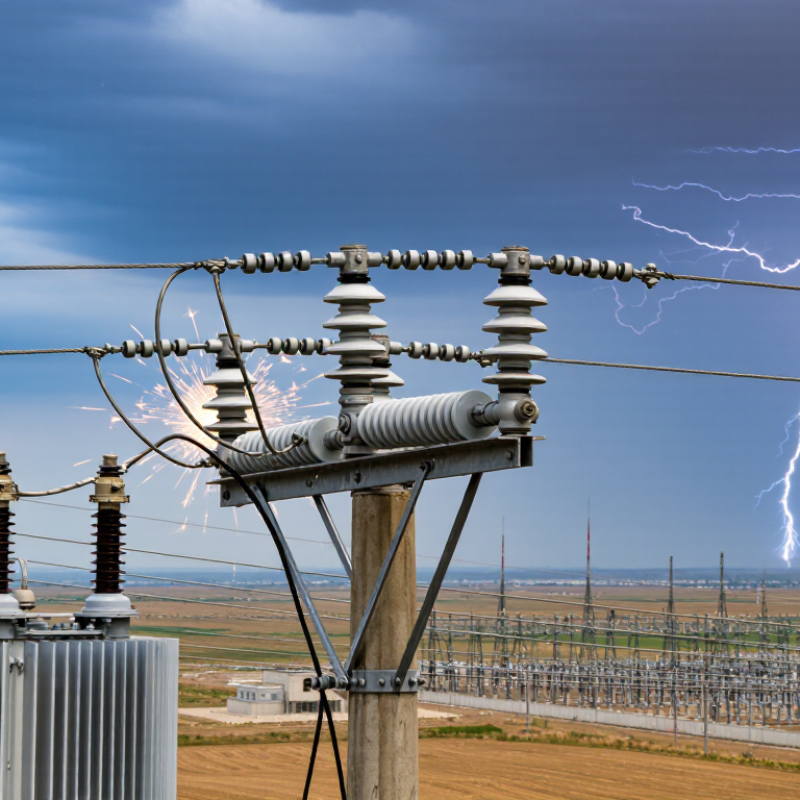
How to Choose the Right Lightning Arrester in 2026?
A lightning arrester limits transient overvoltage before it reaches sensitive equipment. Its role is not to attract lightning. It diverts surge energy safely toward the grounding system. Define this role before comparing technical specifications.
Start with the protected asset. A transformer, solar inverter, data cabinet, and motor may require different protection levels. Record the system voltage, frequency, grounding arrangement, and expected fault conditions. Then check the arrester’s maximum continuous operating voltage, discharge current, energy capability, and voltage protection level. Small details matter. A unit with insufficient energy capacity may fail after repeated surges.
Grounding deserves equal attention. Poor bonding can leave dangerous voltage differences between connected devices. Measure conductor length, routing, and connection quality during site inspection. Coordinate protection at the service entrance and near sensitive loads. Consider indoor or outdoor exposure, pollution, altitude, temperature, and available installation space. Local electrical codes and recognized standards should guide final selection.
A perfect spreadsheet can still mislead. Field conditions often differ from design drawings. One overlooked cable route may change the protection result. Review maintenance access, visual status indicators, and replacement procedures with qualified personnel. Document the decision and question assumptions that seem convenient.
| Protection Requirement | Relevant Parameter | Typical Reference Data | Recommended Arrester Characteristic | Selection and Installation Notes |
|---|---|---|---|---|
| Lightning current entering the installation | Impulse discharge capability | Type 1 testing uses a 10/350 μs current wave; Type 2 testing uses an 8/20 μs current wave. | Use a Type 1 or Type 1+2 device where a direct lightning current may enter through the service or through an external lightning protection system. | The required impulse current rating depends on the lightning protection level, current-sharing arrangement, service configuration, and installation standard. |
| Induced and switching surges | Nominal discharge current, In | Common Type 2 values are 5 kA, 10 kA, 15 kA, or 20 kA with an 8/20 μs waveform. | Select a Type 2 metal-oxide surge arrester with an In suitable for the exposure and prospective surge environment. | A higher In rating generally provides greater surge-current capability, but it does not replace correct voltage selection or coordination. |
| Maximum continuous system voltage | Maximum continuous operating voltage, Uc or MCOV | For a 230/400 V low-voltage system, commonly used phase-to-earth MCOV values are around 255–275 V, depending on the earthing system and product design. | Choose an MCOV that remains continuously stable at the highest normal voltage and at permitted temporary overvoltages. | Do not select only from nominal voltage. Verify phase-to-earth voltage, neutral behavior, fault conditions, and the manufacturer’s temporary-overvoltage data. |
| Protection of sensitive equipment | Voltage protection level, Up | Typical low-voltage SPD protection levels are approximately 1.2–2.5 kV, depending on device class, rated voltage, and test current. | Select an arrester with a Up below the impulse withstand voltage of the protected equipment. | Lower Up is desirable only when the device can withstand the expected surge energy and the installation remains properly coordinated. |
| Direct lightning protection zone boundary | SPD test class or type | Type 1: 10/350 μs impulse current; Type 2: 8/20 μs surge current; Type 3: combination-wave protection near sensitive loads. | Use Type 1 at the incoming boundary when required; use Type 2 downstream; use Type 3 close to particularly sensitive equipment. | A coordinated cascade can reduce residual voltage and distribute surge energy across multiple protection stages. |
| Earthing arrangement | Connection mode and pole configuration | TN-S, TN-C, TT, and IT systems require different conductor connections and voltage considerations. | Use an arrester configuration designed specifically for the supply system, such as L–PE, L–N, or N–PE protection paths. | For TN-C systems, the PEN conductor must be considered; for TT systems, neutral-to-earth protection and residual-current-device coordination are important. |
| Thermal and short-circuit safety | Short-circuit withstand and backup protection | The arrester’s rated short-circuit withstand must be equal to or greater than the prospective short-circuit current at its installation point. | Choose a device with an internal thermal disconnector, status indication, and a specified backup fuse or circuit-breaker arrangement. | Confirm coordination between the arrester, upstream overcurrent protection, conductor cross-section, and local wiring regulations. |
| Installation lead inductance | Connection length and conductor routing | At high-frequency surge fronts, each metre of conductor can add a significant inductive voltage component. | Use short, straight, separated conductors with a low-inductance routing layout. | Keep the total connecting conductor length as short as practical; many installations target approximately 0.5 m or less for the complete connection path. |
| Equipment coordination | Impulse withstand voltage and protection distance | Low-voltage equipment commonly has impulse withstand categories from approximately 1.5 kV to 6 kV, depending on the equipment location and overvoltage category. | Ensure the arrester’s effective protection level, including wiring effects, is below the equipment’s impulse withstand level. | Install additional downstream protection when cable length, separation, or electrical conditions could allow the surge voltage to increase again. |
| Monitoring and maintenance | Status indication and remote signaling | Many modular arresters provide a mechanical end-of-life indicator and optional remote alarm contact. | Use visible status indication for accessible panels and remote contacts where continuity of operation is critical. | Include periodic visual inspection, checking of wiring and backup protection, and replacement after confirmed high-energy operation. |
| Applicable standards | Design, product, and installation requirements | IEC 60099-4 covers metal-oxide surge arresters for AC power systems; IEC 61643-11 covers low-voltage surge protective devices; IEC 62305 addresses lightning protection. | Select equipment with verified test data and conformity to the standard applicable in the installation location. | National wiring rules and utility requirements may add conditions for testing, disconnection, clearances, and installation practices. |