
MON - FRI 8AM - 5PM

How to Choose a Steel Rebar Manufacturer?

Choosing a Steel Rebar Manufacturer is a decision about dependable performance, not just price per tonne. Rebar may arrive bundled at a jobsite, but its quality starts much earlier: in the steelmaking process, rolling controls, testing, and batch records. The World Steel Association’s World Steel in Figures 2024 reports that global crude steel production reached 1,892.2 million tonnes in 2023. That scale offers buyers many options, but production volume alone does not establish product consistency or suitability.

Capacity is expanding, too. The OECD’s Steel Outlook 2024 projects global steelmaking capacity will reach 2.6 billion tonnes by 2026, up 6.7% from 2023. In a crowded market, compare manufacturers against the project’s required grade, dimensions, applicable product standards, and delivery schedule. Ask for recent mill test certificates, heat-number traceability, and clear procedures for handling nonconforming material. A certificate deserves a close read.

A plant visit can reveal practical details that brochures miss: how bundles are labeled, how samples are tested, and whether loading areas protect bars from damage. Independent inspection may also help when orders are large, specifications are demanding, or supply chains cross borders. Still, no checklist can remove every risk. A polished presentation is not proof; verify claims against documents and actual operating practices. The right Steel Rebar Manufacturer should explain its controls plainly and answer specific questions without evasion. This guide outlines the checks that matter, the evidence to request, and the trade-offs worth examining before placing an order. Even experienced buyers can overlook a detail. That is worth remembering.
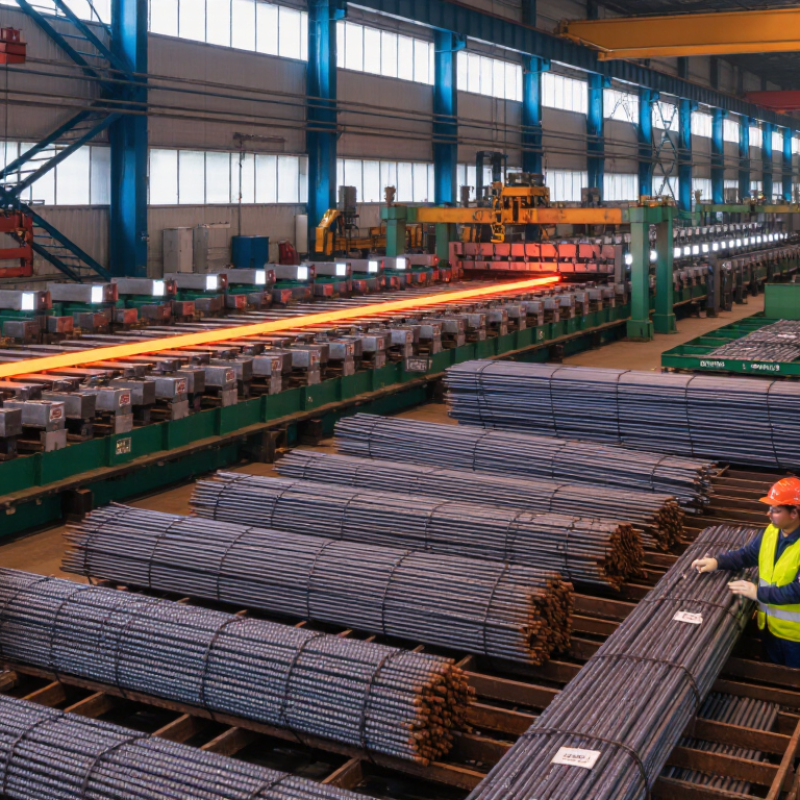
How to Choose a Steel Rebar Manufacturer?

Define Project Loads and Select Rebar by Yield Strength: Grade 60 = 420 MPa

Choosing a steel rebar manufacturer starts with the forces the bar must resist, not just the grade on a quotation. Define dead and live loads, span conditions, and any exposure or seismic demands with the project engineer. Then check the design drawings and applicable project specifications.

Grade 60 rebar has a specified yield strength of 60 ksi, or about 420 MPa. This is the stress level at which the steel begins to deform permanently; it is not a guarantee that every bar performs identically. Check that the manufacturer can supply the specified grade, sizes, and required documentation.

Yield strength is only one selection factor. Bar spacing, lap lengths, bend details, concrete cover, and development length affect how reinforcement works in the structure. Ask for mill test reports that identify the heat and confirm the steel’s properties. If welding or tight bends are planned, verify suitability with the engineer rather than assuming Grade 60 answers every question. Small details matter. It is tempting to choose the highest available strength, but that may not match the design or simplify placement. A realistic review of loads, drawings, and traceability can prevent mismatched material from arriving at the jobsite.

Check ASTM A615/A706 Compliance and Bar Sizes #3–#18

A reliable steel rebar manufacturer should state whether bars meet ASTM A615 or ASTM A706, not rely on a vague “structural grade” label. A615 covers carbon-steel reinforcing bars; A706 sets tighter controls on chemical composition and tensile properties, supporting weldability and applications with stricter ductility needs. Neither specification automatically suits every project. Check the drawings and project requirements before ordering. Request mill test reports showing grade, heat number, yield strength, tensile strength, elongation, and bend-test results. Match the heat number on each report to the bundle tag and, where visible, the bar markings. Details matter.

For sizes #3–#18, confirm the bar schedule, nominal diameter, and required length before comparing quotes. The number identifies a nominal size; a ribbed bar will not measure exactly that diameter across its ribs. Compare unit weight and quantity too, since a size or count mismatch can quietly affect a pour. At delivery, check bundle tags, bar marks, straightness, and visible damage. A caliper reading alone can mislead. Keep records. If paperwork is incomplete, pause and ask for clarification rather than assuming the bars match the order. One easy-to-miss check is verifying the applicable specification edition and project-specific acceptance requirements. It shouldn’t be.

Compare Mill Test Reports for Chemistry, Tensile, and Bend Results

When choosing a steel rebar manufacturer, read the mill test report (MTR) heat by heat. Match its heat number to the bundle tag and delivery documents. Then compare reported chemistry with the project specification, not just a generic product sheet. For ASTM A706/A706M rebar, carbon equivalent is limited to 0.55%, supporting weldability control. Check the listed carbon, manganese, and other reported elements, and ask the mill to explain any missing or unclear values. A neat certificate can still leave questions.

Tensile results need equal scrutiny. ASTM A706/A706M Grade 60 sets a 60 ksi minimum yield strength and an 80 ksi minimum tensile strength; it also requires a tensile-to-yield ratio of at least 1.25. Compare actual results with these limits and the specified grade, while checking elongation and test units. ASTM A615/A615M uses different tensile requirements, so do not compare grades by yield strength alone. Bend results should identify the test outcome and applicable bar size. Look for cracking or recorded failures, then confirm the test followed the cited standard. Small details matter.

Treat inconsistencies as a reason to pause, not as proof of bad steel. ASTM requirements are a baseline; project documents may be stricter. If chemistry, tensile, or bend data are absent, request corrected traceable records before acceptance. I would also verify sampling and test dates; that step is easy to overlook.

How to Choose a Steel Rebar Manufacturer? - Compare Mill Test Reports for Chemistry, Tensile, and Bend Results

Reference criteria below are for ASTM A706/A706M Grade 60 (Grade 420) reinforcing bars. They are specification requirements, not test results from a particular mill. Confirm the contract’s specified standard and edition before evaluating a Mill Test Report (MTR).

MTR category What to check on the MTR ASTM A706 Grade 60 reference How to assess the result
Traceability Heat number, bar size, grade, specification, and test identification The MTR should identify the product and the applicable specification clearly. Check that the heat number and bar size match the delivered bundle tags and purchase documents.
Chemistry: carbon (C) Actual heat-analysis percentage by weight Maximum 0.30% Compare the reported value with the maximum in the specified standard and purchase requirements.
Chemistry: manganese (Mn) Actual heat-analysis percentage by weight Maximum 1.50% Confirm the value is within the specified limit; do not rely on a grade name alone.
Chemistry: phosphorus (P) Actual heat-analysis percentage by weight Maximum 0.035% Verify the MTR reports a numerical result and that it meets the applicable limit.
Chemistry: sulfur (S) Actual heat-analysis percentage by weight Maximum 0.045% Compare the reported result with the standard’s maximum and any tighter project limit.
Carbon equivalent (CE) Reported CE and the calculation basis, where provided Maximum 0.55% for A706; use the formula and requirements in the specified edition. A compliant CE supports weldability assessment, but it does not replace project welding procedures or code requirements.
Yield strength Measured tensile-test result, reported in ksi or MPa Minimum 60 ksi (420 MPa); maximum 78 ksi (540 MPa) Check both the minimum and maximum. A result above the specified maximum is not automatically acceptable.
Tensile strength Measured tensile strength from the test specimen Minimum 80 ksi (550 MPa) Confirm the result meets the minimum and is reported for the same heat and product grade.
Tensile-to-yield ratio Tensile strength divided by yield strength, where required by the specified edition Minimum ratio 1.25 Check the ratio as well as the individual strength results; confirm the values use consistent units.
Elongation Measured percentage elongation and specimen gauge length Minimum depends on bar size and the applicable standard table. Compare against the requirement for the specific bar size; do not apply one minimum to every size.
Bend test Test method, bar size, bend angle, bend-pin diameter, and visual result Bend requirements are size-specific. The bent specimen must meet the applicable standard’s acceptance criteria, including no cracking on the outside of the bent portion. Confirm the test conditions match the specified size and edition. Ask for clarification if the MTR gives no bend result or test details.

Selection tip: prefer MTRs that provide complete, traceable heat-analysis and mechanical-test results, clearly identify the applicable standard, and match the delivered material. Project specifications and the specified standard edition take precedence over this summary.

Evaluate Dimensional Tolerances, Heat-Number Traceability, and Quality Controls

How to Choose a Steel Rebar Manufacturer?

Evaluate Dimensional Tolerances, Heat-Number Traceability, and Quality Controls

A reliable purchase starts with measurable checks, not polished brochures. World Steel Association reported 1,888.2 million tonnes of crude steel production in 2023, a reminder of the scale behind today’s supply chains. For rebar, check diameter, rib pattern, length, and mass per metre against the specification in your order. ASTM A615/A615M sets requirements for dimensions, tensile properties, and bend testing; confirm the exact edition your project requires. Use calibrated callipers and a scale to spot-check delivered bundles. Small deviations can affect fit, lap lengths, and concrete cover.

Traceability matters. Each bundle tag should show a heat number that matches the mill test certificate. Check that the certificate records chemistry, yield strength, tensile strength, and elongation, then compare the listed grade and bar size with the order. Keep the tags and delivery records together. A clean document trail helps link a questionable bar back to its production batch.

Paperwork can still be wrong.

Ask how the manufacturer controls sampling, equipment calibration, and nonconforming material. Review recent test records, not just a quality-system certificate. If results vary, ask what corrective action followed and whether affected batches were isolated. A practical audit includes watching a sample get marked, measured, and recorded. It takes time. Still, a neat certificate alone cannot prove that the bars in your yard match the tested heat.

Verify Production Capacity, Delivery Lead Times, and Third-Party Certifications

When evaluating a steel rebar manufacturer, ask for recent production records, not just stated annual capacity. World Steel Association’s World Steel in Figures 2024 reports 1,892.2 million tonnes of crude steel production worldwide in 2023. That scale shows a large, active industry; it does not prove that one mill can supply your order on time. Ask for the specific rolling line, monthly output, current backlog, and production schedule for your bar sizes and grades. Ask for evidence. A site visit or live video tour can help confirm equipment and stock, though neither replaces documented records.

Delivery promises need dates and conditions. Request a written lead-time estimate covering production, testing, loading, and transport, then compare it with recent shipment records. Clarify how the supplier handles changes in quantity, port congestion, or failed inspection. Leave a buffer. Schedules can slip, and I would not treat a best-case estimate as a reliable plan. For certification, verify the certificate number, issuing body, validity, and facility address directly with the certifier. Check that its scope covers the relevant product and manufacturing site. Request heat-specific test reports showing chemical composition and mechanical properties, and confirm the bars meet the project’s specified standard. A certificate alone is not proof that every shipment conforms.

How to Choose a Steel Rebar Manufacturer

Verify production capacity, delivery lead times, and third-party certifications before placing an order.

How to read this chart: The 100% bars are verification targets, not market averages. Confirm capacity with production records, lead times with a written schedule, and certifications with the issuing body and the certificate’s scope and validity.

Request a Quote

To learn more about any of the products and services provided by Abbott Ball Company, Inc., simply complete the form below.