MON - FRI 8AM - 5PM

China Best Large Ball Bearings Suppliers?

Choosing China’s best large ball bearings suppliers requires more than comparing catalog prices. Buyers must examine load ratings, steel quality, heat treatment, sealing design, and production consistency. A bearing may look impressive on paper. Its performance can change under dust, vibration, misalignment, and continuous high speed.

Dr. Tedric A. Harris, a respected rolling-bearing researcher, emphasized, “Bearing life is a statistical concept, not a guarantee.” This principle matters when evaluating large ball bearings for cranes, wind turbines, gearboxes, and heavy industrial equipment. A reliable supplier should provide traceable material records, dimensional inspection reports, fatigue-testing data, and clear tolerance information. Factory experience also matters. Ask how suppliers control raceway roughness, ball-grade variation, lubrication volume, and final assembly cleanliness.

Look closely at communication.

The strongest Chinese manufacturers usually combine modern grinding lines with experienced application engineers. They can recommend internal clearance, cage materials, preload, and sealing options for a specific operating environment. However, no supplier should be trusted only because of a polished website or a familiar certificate. Independent sample testing remains valuable. It can reveal noise, torque, hardness, and vibration problems before installation.

This guide compares leading China-based suppliers through practical criteria, including manufacturing capability, customization, quality management, delivery reliability, and after-sales support. Some evaluations may remain imperfect because public supplier data is not always complete. Still, a careful shortlist can reduce costly failures and help buyers select large ball bearings that match real operating conditions.
China Best Large Ball Bearings Suppliers?

Definition and Applications of Large Ball Bearings

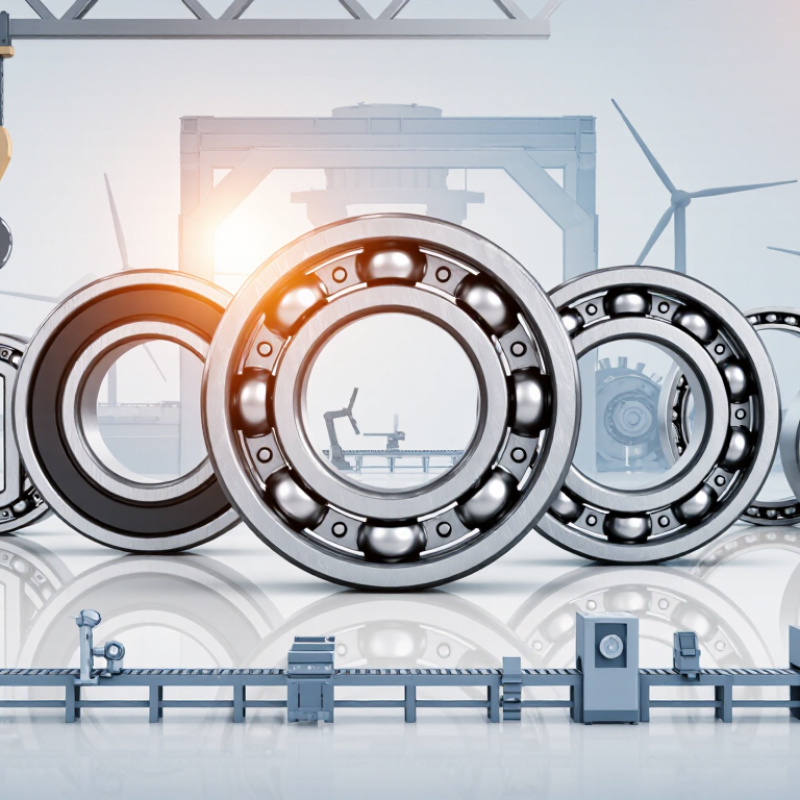
Large ball bearings are mechanical components designed to support heavy radial loads and, in some designs, limited axial loads. Their rolling balls reduce friction between rotating rings. Compared with standard bearings, they usually have larger diameters, thicker rings, and stronger internal structures. Size alone does not guarantee better performance. Load direction, speed, temperature, and installation accuracy matter more than many buyers expect.

These bearings are used in cranes, mining equipment, wind turbines, industrial gearboxes, and heavy conveyors. A crane slewing system may need smooth rotation under uneven loads. A mining machine may face dust, vibration, and shock every day. Proper sealing helps protect the raceway from contamination. Correct lubrication reduces heat and wear.

In field inspections, unusual noise, rising temperature, and metal particles in grease often signal trouble. Still, diagnosis can be imperfect without vibration testing and load records.

Tips: Check static and dynamic load ratings before comparing suppliers. Ask for material certificates, dimensional reports, heat-treatment records, and fatigue-test data. Confirm whether the bearing suits continuous rotation or intermittent movement. Installation tools also deserve attention; a small alignment error can shorten service life. Some specifications look impressive on paper but fail under real working conditions. A practical trial remains valuable.
Key Selection Criteria for Chinese Large Ball Bearing Suppliers

Selecting China’s best large ball bearing suppliers requires more than comparing quotations. Grand View Research estimated the global bearings market at about USD 128 billion in 2023, reflecting intense demand for industrial equipment and transport systems. This scale makes supplier screening essential. I examine load ratings, operating speed, steel certificates, heat-treatment records, and production capacity. Large bearings need consistent metallurgy, not attractive packaging.

ISO 281:2007 defines bearing rating life at 90% reliability, while ISO 76:2006 addresses static load ratings. Ask suppliers for calculations based on these standards. Request dimensional inspection reports, hardness results, vibration data, and fatigue-test records. Traceability should connect each bearing to its steel batch, machining line, and final inspection. Clear evidence matters.

Small details reveal factory discipline. Check whether protective wrapping survives humid sea freight. Review storage temperatures, grease specifications, and replacement-part availability. A low quote can hide unstable tolerances. I have seen polished audit rooms conceal weak documentation. My checklist is not perfect, either. Therefore, verify samples through an independent laboratory when the application carries heavy radial or axial loads. Supplier communication also deserves testing: send one technical drawing revision and measure response accuracy, not just response speed. Reports from the China Bearing Industry Association can help compare sector output and export trends, but company-level evidence remains decisive.

Major Types of Large Ball Bearings Available in China

China offers several major types of large ball bearings for heavy machinery, wind equipment, mining systems, and industrial turntables. Deep groove ball bearings are common for radial loads and moderate axial loads. Their simple structure supports easier maintenance and economical replacement. Angular contact ball bearings handle combined loads, making them useful in machine tools, pumps, and precision drive systems.

Spherical ball bearings can accommodate shaft misalignment, which helps when housings flex under heavy operation. They are often selected for conveyors, crushers, and large fans. Thrust ball bearings mainly carry axial loads. They suit vertical shafts, indexing tables, and low-speed positioning equipment. Four-point contact bearings combine radial and axial capacity in a compact arrangement. They can reduce space, but their actual performance depends strongly on preload and mounting accuracy.

China-based suppliers may provide standard, customized, or split designs for large applications. Ask for load calculations, material certificates, heat-treatment records, and dimensional inspection reports. Check the running clearance, cage material, sealing method, and grease compatibility before ordering. A supplier should explain fatigue life assumptions instead of offering only a catalog diameter. I have found that drawings often hide installation risks. Shaft deflection, contamination, and poor storage can damage a good bearing quickly. No selection method is perfect. Field temperature, vibration, speed changes, and maintenance access still need practical review. Sample testing under real loads can reveal problems that paperwork misses.

Quality Standards, Manufacturing Processes, and Testing

China Best Large Ball Bearings Suppliers?

Quality begins with documented standards, not attractive packaging. Reliable suppliers control steel chemistry, hardness, dimensional accuracy, and surface finish. They should provide traceable inspection records for every production batch. Large bearings require careful heat treatment because uneven hardness can cause early cracking. Manufacturing often includes forging, turning, grinding, and precision assembly. Each stage needs measured tolerances. Small errors matter.

Testing should reflect real operating conditions. Inspectors commonly check radial clearance, vibration, noise, roundness, and rotational torque. Load testing can reveal weaknesses that visual checks miss. Temperature monitoring is also useful during extended running tests. Ask for material certificates and calibrated equipment records. Witness testing when possible. However, no test plan is perfect. Dust, mounting errors, and lubrication changes can affect results. A supplier that explains these limitations appears more trustworthy than one promising flawless performance.

Tips: Compare inspection methods, not only prices. Request sample reports with serial numbers and test conditions. Confirm whether testing covers seals, cages, and raceways. Visit the factory if practical, and watch how workers protect finished surfaces. Keep a written specification before ordering. It prevents later arguments. Also, review failure feedback from previous projects. Honest feedback is sometimes uncomfortable, but it improves supplier selection.

How to Evaluate and Choose a Reliable Supplier

China Best Large Ball Bearings Suppliers? How to Evaluate and Choose a Reliable Supplier

Choosing a reliable Chinese supplier requires more than comparing quotations. A 2024 Grand View Research report estimates the global ball bearing market at over USD 8 billion, showing strong demand and intense competition. Low prices can hide inconsistent steel quality, poor heat treatment, or unstable delivery. Ask for ISO 9001 certification, recent audit records, material certificates, and batch-level traceability. The supplier should also explain its testing process clearly.

Technical evidence matters. Check dimensional reports against ISO 199 and rating calculations against ISO 281. Request vibration, noise, hardness, clearance, and load-test results from the same production batch. A capable factory should provide serial numbers, inspection photos, and retention samples. Verify whether testing is performed internally or by an independent laboratory. That detail changes confidence.

Visit the plant when possible. Observe grinding areas, cleanliness, storage conditions, and calibration labels. Ask how rejected parts are isolated. The U.S. Department of Energy notes that correct lubrication and alignment can significantly reduce bearing energy losses, so supplier support should include installation guidance. Delivery data also deserves scrutiny; request twelve months of on-time shipment records, not a single impressive example. A certificate can look perfect. It may still prove very little. I would begin with a small pilot order, measure failure rates, and revise the checklist after real operation. No evaluation method is flawless.

China Best Large Ball Bearings Suppliers? - How to Evaluate and Choose a Reliable Supplier

Practical supplier-evaluation benchmarks for large-diameter ball bearings

Evaluation Dimension What to Verify Reliable-Supplier Benchmark Recommended Evidence Weight
Product Size Capability Bore diameter, outside diameter, section height, weight, and maximum production envelope Documented capability for the required dimensions, including oversized or custom configurations Dimension drawings, capacity list, inspection records, and approved sample 15%
Load-Rating Accuracy Dynamic load rating, static load rating, axial load, radial load, and combined-load calculations Ratings calculated using recognized bearing-industry methods and matched to the actual application duty cycle Load calculations, technical data sheet, application review, and engineering sign-off 14%
Material and Heat Treatment Bearing steel grade, hardness, cleanliness, carburizing or through-hardening process, and retained austenite control Full material traceability and heat-treatment records for each production batch Mill certificates, heat-treatment charts, hardness reports, and batch identification 13%
Manufacturing Precision Dimensional tolerance, roundness, runout, surface finish, internal clearance, and noise or vibration control Inspection limits defined before production and measured with calibrated equipment Control plan, capability data, calibration certificates, and final inspection report 15%
Sealing and Lubrication Seal material, grease type, operating temperature, relubrication interval, and contamination protection Lubricant and seal selection supported by operating-temperature and environmental requirements Lubrication specification, compatibility statement, seal drawings, and application guidance 9%
Quality Management Process control, nonconformance handling, corrective action, and document retention A documented quality-management system with traceable inspection and corrective-action procedures Valid management-system certificate, audit report, quality manual, and sample records 12%
Testing and Validation Noise, vibration, rotational torque, endurance, temperature rise, and dimensional testing Testing plan aligned with the bearing’s size, speed, load, and service environment Test reports, laboratory equipment list, calibration records, and validation samples 8%
Production Lead Time Tooling, forging, machining, heat treatment, assembly, inspection, and export preparation Typical custom-order lead time is clearly stated in writing; schedule milestones are measurable and realistic Production schedule, capacity plan, tooling timeline, and on-time-delivery history 5%
Traceability and Packaging Serial or batch numbers, corrosion protection, shock resistance, lifting instructions, and export packaging Each bearing can be linked to material, process, inspection, and shipment records Traceability sample, packaging specification, photographs, and packing list 4%
Commercial and Technical Support Engineering response, warranty terms, spare-part support, communication, and total landed cost Transparent quotation, defined warranty conditions, responsive technical support, and stable after-sales service Detailed quotation, warranty policy, response-time record, reference projects without undisclosed branding 5%
Suggested decision rule
Select suppliers scoring at least 80/100, provided that material traceability, load calculations, dimensional inspection, and sample validation are all acceptable.
Important caution
Do not compare price alone. For large bearings, incorrect load selection, poor heat treatment, inadequate lubrication, and transport damage can create substantially higher lifecycle costs.

Request a Quote

To learn more about any of the products and services provided by Abbott Ball Company, Inc., simply complete the form below.