Choosing the right stainless steel requires more than comparing price tags. Buyers must examine chemistry, processing conditions, surface finish, and service temperature. The most discussed grade is 316 stainless steel, valued for its molybdenum content and improved resistance to chlorides.
Harold M. Cobb, a respected stainless-steel historian and materials authority, explains the central issue clearly: “Stainless steel is not one material, but a family of alloys.” That distinction matters. The 316 stainless steel properties can support marine fittings, pharmaceutical equipment, food-processing parts, and architectural components. However, performance changes with welding, contamination, crevices, and exposure time. A polished sheet beside seawater may behave differently from a rough welded joint.
Look closely.
This guide examines corrosion resistance, tensile strength, hardness, temperature performance, weldability, and practical maintenance. It also compares 316 with 304 stainless steel, because buyers sometimes choose 316 without confirming the environment. That can increase costs without delivering meaningful benefits. In other cases, selecting 304 may create premature staining, especially near salt spray or chemical residues.
Reliable purchasing decisions need evidence. Check mill certificates, applicable standards, test reports, and the supplier’s traceability records. Ask where the material will operate, not only how it looks today. A small design detail, such as a trapped-water pocket, can undermine an otherwise suitable alloy. Some specifications also deserve a second look. “Marine grade” sounds reassuring, but it is not always a precise technical designation. The goal is not to buy the strongest stainless steel available. It is to match verified 316 stainless steel properties with real operating demands.
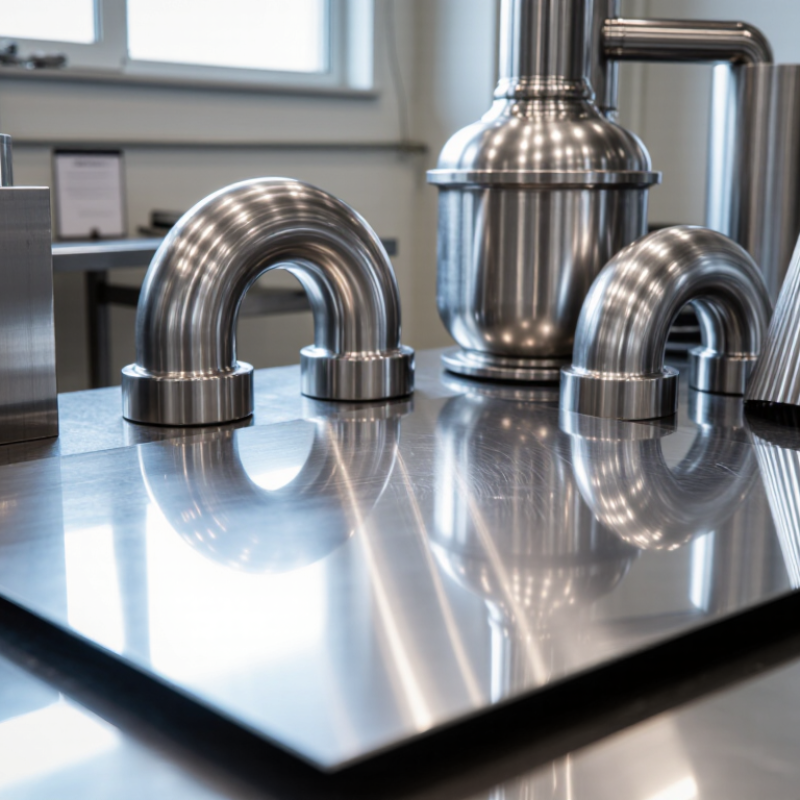
316 stainless steel is an austenitic stainless alloy containing chromium, nickel, and molybdenum. ASTM A240 specifies approximately 16–18% chromium, 10–14% nickel, and 2–3% molybdenum. This chemistry gives 316 stronger resistance to chlorides than 304 stainless steel.
Molybdenum helps reduce pitting around saltwater, coastal air, and chemical-processing equipment. The material remains non-magnetic after normal annealing. Its typical density is about 8.0 g/cm³. For annealed plate, ASTM A240 lists a minimum tensile strength of 515 MPa and a minimum yield strength of 205 MPa. These figures support tanks, piping, heat exchangers, and food-processing surfaces.
Demand reflects practical use. The International Stainless Steel Forum reported global crude stainless steel production of about 58.4 million tonnes in 2023. However, 316 is not a universal solution. Persistent seawater exposure can still cause crevice corrosion, especially beneath deposits, gaskets, or poorly cleaned welds. Site inspection matters. Fabricators should remove heat tint and confirm the required surface finish after welding. Buyers should also verify mill certificates, dimensions, and corrosion conditions before ordering. The alloy performs well, but careless design can still defeat good material.
China’s best 316 stainless steel begins with verified chemistry, not surface shine. ASTM A240/A240M specifies 16–18% chromium, 10–14% nickel, and 2–3% molybdenum. Carbon must remain below 0.07%. For 316L, the limit falls to 0.03%, improving weld-area corrosion resistance. Molybdenum is the key difference from 304 stainless steel. It strengthens resistance against chloride pitting and crevice attack. Nitrogen also matters. The PREN formula, Cr + 3.3Mo + 16N, gives a practical comparison tool. Typical 316 values produce a PREN near 24–26.
Real performance depends on processing. Technical guidance from the Nickel Institute notes that contamination, rough grinding, and poor drainage can defeat good alloy chemistry. A clean, properly passivated surface performs better than a neglected one. ASTM G48 testing is widely used to measure pitting and crevice corrosion resistance, but laboratory results do not predict every marine or chemical environment. This is easy to overlook. Buyers should request heat-lot test certificates, PMI verification, surface-finish records, and weld inspection results. Chloride concentration, temperature, and exposure time need review together. In hot saltwater, even 316 can pit. No alloy is magic. Trojan? no. Avoid. A slightly lower carbon grade may be the safer choice for welded tanks, piping, and outdoor equipment, though design details still require engineering review.
The chart shows the ASTM A240 specification limits for the chemical composition of Type 316 stainless steel, expressed as weight percentages. Chromium and nickel support the passive stainless-steel surface, while molybdenum significantly improves resistance to localized corrosion such as pitting and crevice corrosion in chloride-containing environments. A typical PREN estimate for 316 stainless steel is approximately 24–28, depending on the actual chromium, molybdenum, and nitrogen content. Corrosion performance also depends on temperature, chloride concentration, surface condition, welding, and exposure conditions.
China Best 316 Stainless Steel Properties for Buyers?
316 stainless steel is valued for its molybdenum content and strong resistance to chloride corrosion. For buyers, mechanical data should match the supplied condition. Annealed sheet commonly offers tensile strength near 515 MPa, yield strength around 205 MPa, and elongation above 40%. Cold working can raise strength, but it may reduce ductility and increase forming stress. Hardness is usually controlled rather than maximized.
Thermal behavior matters near heat exchangers, pipes, and process equipment. 316 stainless steel conducts heat poorly compared with carbon steel, with thermal conductivity near 16 W/m·K at room temperature. Its thermal expansion is approximately 16 × 10⁻⁶/K. Repeated heating can create distortion, especially in thin welded sections. Continuous high-temperature exposure also requires engineering review. A simple temperature limit is not enough.
Fabrication performance is generally dependable. TIG, MIG, and laser welding work well when heat input and shielding are controlled. The weld area should receive proper cleaning and passivation when corrosion resistance is critical. Machining can produce work hardening, so sharp tools, steady feeds, and adequate coolant are important. Forming is practical, but springback deserves attention. I would not approve material from a polished certificate alone. Heat numbers, chemical analysis, mechanical tests, surface condition, and dimensional checks should agree. This extra review can reveal small issues before cutting begins. Some purchasing teams overlook that point.
| Property Category | Property | Typical Value or Characteristic | Buyer-Relevant Notes |
|---|---|---|---|
| Material Identification | Common designation | AISI 316 / UNS S31600 | The low-carbon version is 316L / UNS S31603 and is commonly selected for welded components. |
| Chemical Composition | Chromium | 16.0–18.0 wt.% | Provides the passive chromium-oxide film responsible for stainless corrosion resistance. |
| Chemical Composition | Nickel | 10.0–14.0 wt.% | Stabilizes the austenitic structure and supports ductility and formability. |
| Chemical Composition | Molybdenum | 2.0–3.0 wt.% | Improves resistance to chloride-induced pitting and crevice corrosion compared with 304 stainless steel. |
| Physical | Density | Approximately 8.0 g/cm³ | Useful for calculating component weight, shipping weight, and material usage. |
| Mechanical | Ultimate tensile strength | Minimum 515 MPa for annealed plate and sheet | Actual values depend on product form, thickness, heat treatment, and applicable specification. |
| Mechanical | Yield strength | Minimum 205 MPa at 0.2% offset for annealed 316 | 316L commonly has a minimum yield strength of approximately 170 MPa under ASTM A240 requirements. |
| Mechanical | Elongation | Minimum about 40% in 50 mm for annealed plate and sheet | High elongation supports deep drawing, bending, and other cold-forming operations. |
| Mechanical | Hardness | Typically up to 217 HB or 95 HRB in annealed condition | Cold working can substantially increase hardness and strength. |
| Mechanical | Elastic modulus | Approximately 193 GPa at room temperature | Use this value for stiffness and deflection calculations; it is lower than that of carbon steel. |
| Thermal | Thermal conductivity | Approximately 14–16 W/m·K at room temperature | Lower conductivity than carbon steel and aluminum may increase temperature gradients during fabrication. |
| Thermal | Specific heat capacity | Approximately 500 J/kg·K at room temperature | Relevant to heating, cooling, welding, and thermal-processing calculations. |
| Thermal | Mean coefficient of thermal expansion | Approximately 15.9 × 10⁻⁶/K from 20–100°C | Thermal expansion should be considered in long structures, precision assemblies, and welded parts. |
| Thermal | Melting range | Approximately 1,370–1,400°C | The material remains austenitic over a wide temperature range but may require controlled welding heat input. |
| Corrosion Resistance | General performance | Very good resistance in many atmospheric, chemical, food, and marine-related environments | Performance depends on chloride level, temperature, deposits, crevices, surface condition, and exposure time. |
| Corrosion Resistance | Pitting resistance equivalent number | Typically around PREN 24–26, depending on actual composition | PREN is a comparative indicator, not a guarantee of performance in a specific service environment. |
| Fabrication | Cold forming | Excellent ductility and formability | Expect work hardening, higher forming forces, and potential springback compared with mild steel. |
| Fabrication | Weldability | Generally excellent by TIG, MIG, plasma, resistance, and other standard processes | Use clean tooling and suitable filler metal; 316L is preferred when reduced sensitization risk is important. |
| Fabrication | Post-weld heat treatment | Normally not required for most fabricated sections | Pickling and passivation may be required to restore the surface after welding and remove heat tint. |
| Fabrication | Machinability | Fair to difficult compared with low-carbon steel | Use sharp, rigid tooling, positive feeds, adequate coolant, and avoid rubbing because of rapid work hardening. |
| Surface and Finishing | Recommended surface treatment | Cleaning, pickling, passivation, electropolishing, or mechanical polishing as required | A clean, smooth, and properly passivated surface improves corrosion performance and appearance. |
| Standards and Inspection | Typical procurement references | ASTM A240, ASTM A276, ASTM A312, EN 1.4401, and EN 1.4404, depending on product form | Confirm the applicable standard, heat number, mill test certificate, dimensions, surface finish, and testing requirements before purchase. |
Values are typical or specification-based references for annealed 316 or 316L stainless steel and may vary with product form, thickness, heat treatment, manufacturing standard, and test method.
China-made 316 stainless steel should be judged by chemistry, processing, and traceability, not origin. Its typical composition includes 16–18% chromium, 10–14% nickel, and 2–3% molybdenum. The molybdenum improves resistance to chloride pitting. The Nickel Institute identifies this advantage in marine, coastal, and chemical-processing environments.
Compared with 304 stainless steel, 316 usually performs better around salt spray and cleaning chemicals. However, 304 can remain the practical choice for indoor equipment and dry food-contact areas. Duplex 2205 offers higher strength and strong chloride resistance, but welding control becomes more demanding. Carbon steel costs less initially, yet rust protection adds maintenance and coating expenses.
The World Stainless Stainless Steel in Figures 2024 report recorded about 58.4 million tonnes of global crude stainless production in 2023. That scale shows why supply capacity alone proves little. In real purchasing, I would inspect heat numbers, mill certificates, ultrasonic testing, and surface condition. Ask for independent chemical verification when the application is critical. Certificates can look complete.
A small but important weakness remains. Some buyers compare only price per tonne. That ignores machining loss, delivery consistency, and corrosion-related replacement costs. China's manufacturing base can deliver excellent 316 products, but quality varies between mills and production batches. A clear specification matters more than a confident sales promise.
When buying 316 stainless steel from China, check the product’s actual grade before comparing prices. 316 steel typically contains molybdenum, which improves resistance to chlorides and coastal moisture. Ask for a current chemical composition report, not only a product description. Confirm carbon content, nickel content, and molybdenum content against the agreed standard.
A shiny surface proves little. Inspect the finish under clear lighting and check for scratches, pitting, discoloration, or uneven polishing. Measure thickness, width, diameter, and flatness at several points. Small differences can affect installation and service life. Request heat numbers, batch records, and material certificates that match the delivered goods. Independent laboratory testing may be sensible for critical applications.
Think about the working environment. Salt spray, cleaning chemicals, high temperatures, and welding can change performance. Ask whether the chosen form supports fabrication, bending, or welding. Poor storage can also create problems; products should arrive dry, protected, and separated from carbon steel dust. Do not accept vague claims about “best quality.” Define inspection methods, sampling rates, packaging details, and replacement terms in writing. One overlooked detail remains common: buyers sometimes select 316 steel without checking whether 316L is more suitable for welded assemblies. The cheaper option may not be the safer option. Recheck the application before placing the order.
To learn more about any of the products and services provided by Abbott Ball Company, Inc., simply complete the form below.