
MON - FRI 8AM - 5PM

What Is the Best Wall Mounted Battery in China?

Choosing the best wall mounted battery in China is not a simple contest of capacity figures. A unit rated at 10 kWh may suit one household, yet feel undersized in another. The answer depends on daily electricity use, backup priorities, inverter compatibility, and available wall space. Even the battery’s location matters: a shaded utility room is not the same as a hot garage. Small details count.

Energy scholar Vaclav Smil offers a useful reminder: “Energy transitions are inherently prolonged affairs.” That perspective helps keep expectations realistic. A wall mounted battery is a long-term household investment, not a quick fix for every power concern. Buyers should compare usable capacity, cycle-life conditions, warranty coverage, safety certifications, and local service access. Marketing claims deserve a closer look. So do installation requirements.

This guide examines Chinese wall mounted battery options through practical questions: How much energy can the system actually deliver? Can it work with the home’s existing solar equipment? What support is available after installation? Price matters, of course. But the lowest quote may leave important costs unclear. One point is easy to miss: published specifications do not guarantee identical results in every home. Careful comparison—and advice from a qualified installer—can narrow the choices without pretending there is one universal winner.
What Is the Best Wall Mounted Battery in China?

What Is a Wall-Mounted Battery and How Does It Work?

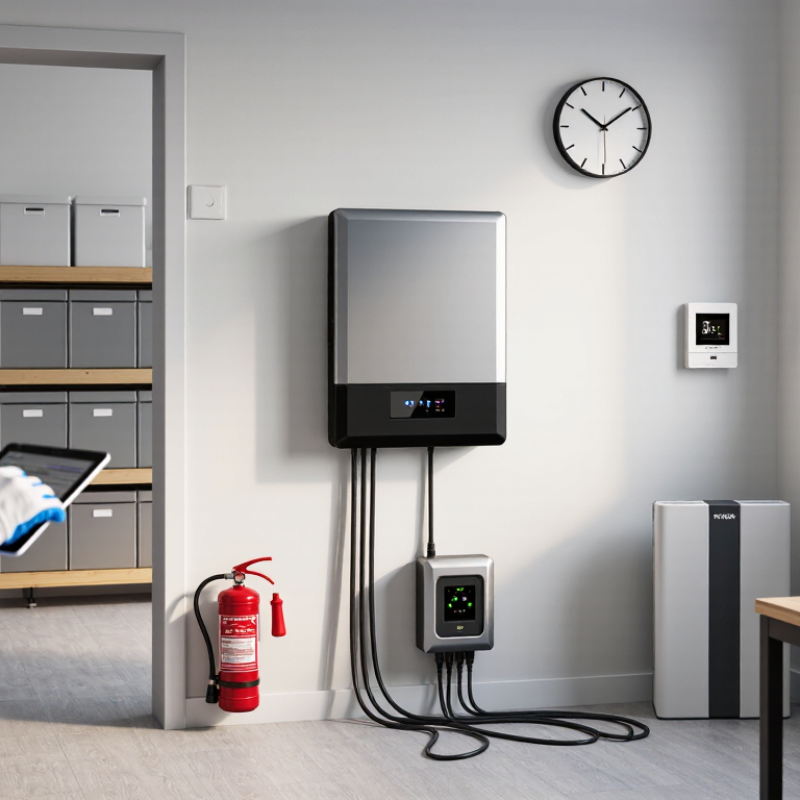
A wall-mounted battery is a rechargeable energy storage unit fixed to a sturdy wall, often near a home’s electrical panel. It stores electricity from rooftop solar panels or the grid for later use. Inside, battery cells hold energy as direct current, while an inverter converts it into alternating current for household appliances. A control system monitors charge, temperature, and power flow. When solar output drops, the battery can help run lights, a refrigerator, or other connected loads. Not magic.

The IEA’s 2024 Batteries and Secure Energy Transitions report says global battery storage capacity needs to grow sixfold, reaching 1,500 GW by 2030. That figure covers energy storage broadly, not just home units, but it reflects the growing role of batteries in balancing electricity supply. In daily use, stored energy may reduce evening grid purchases; backup during an outage depends on the system’s wiring and settings. A wall mount saves floor space, but the wall must support the unit’s weight, and installers need to respect ventilation and temperature guidance. One detail is easy to overlook: batteries have conversion losses, so stored energy returned to appliances is less than the amount originally charged. Check usable capacity, power output, and warranty terms—not just the headline capacity.

Which Features Define a High-Quality Wall-Mounted Battery?

A high-quality wall-mounted battery is defined by more than its advertised capacity. Check usable energy, continuous output, and round-trip efficiency: these determine how much power reaches your home and which appliances can run together. NREL’s 2024 Annual Technology Baseline uses 85% round-trip efficiency for utility-scale lithium-ion storage. That is a useful reference, not a promise for a residential unit. Ask for independently tested figures under stated operating conditions.

Safety and durability matter behind the casing. Look for a battery management system that monitors cell voltage, temperature, and charge, plus clear protection and fault-reporting details. Thermal testing and recognized product certifications should be documented, not merely mentioned in sales copy. Check the stated cycle life and warranty terms, including retained capacity and temperature limits. A long warranty is less reassuring if exclusions are hard to understand.

Installation fit is practical, too. Measure the wall, confirm its load capacity, and check ventilation and service access. Review the system’s operating temperature range, noise level, and compatibility with the inverter and household load. Small details count. A sleek enclosure can still be awkward to maintain. Specifications can also look better than real-world performance; compare test conditions and request written evidence before choosing.

What Is the Best Wall-Mounted Battery in China? Which Features Define a High-Quality Wall-Mounted Battery?

Feature Practical Quality Indicator Why It Matters What to Verify
Battery chemistry Lithium iron phosphate (LFP) is a common choice for stationary home storage because of its thermal stability and long cycle-life potential. Chemistry affects safety characteristics, usable energy, service life, and operating requirements. Check the product datasheet for the stated chemistry and confirm that the battery management system is designed for it.
Usable capacity Residential wall-mounted models are commonly offered in modules of roughly 5–15 kWh; available sizes vary by system. Usable capacity determines how much household load can be supported after accounting for the allowed depth of discharge. Compare usable capacity—not only nominal capacity—and match it to household consumption and backup needs.
Depth of discharge (DoD) Many systems specify a usable DoD in the region of 80–100%, subject to the manufacturer’s operating limits. A higher usable fraction can provide more energy from the same nominal battery capacity. Confirm the permitted DoD, reserve settings, and whether the stated capacity is measured at the battery or system level.
Cycle life and capacity retention Some LFP products advertise several thousand cycles, often under defined test conditions such as specified temperature, DoD, and charge rate. Cycle-life figures are meaningful only when their test conditions and end-of-life capacity threshold are clear. Ask for the cycle-test conditions and the guaranteed remaining capacity at the end of the warranty period.
Continuous power Check the continuous charge and discharge power in kilowatts; the appropriate rating depends on the inverter and household loads. Energy capacity describes how long a battery can supply power, while power rating describes how much it can supply at once. Verify continuous and peak power ratings, peak duration, and whether the battery and inverter can deliver them together.
Round-trip efficiency A system-level figure around 90% or higher can be a useful comparison point, but results depend on the test method and operating conditions. Higher efficiency means less energy is lost during charging and discharging. Compare figures measured on the same basis and check whether they include the inverter and auxiliary consumption.
Battery management system (BMS) A quality BMS monitors cell voltage and temperature and manages overcharge, over-discharge, overcurrent, and temperature protection. Monitoring and protective controls help keep the battery within its specified operating limits. Check fault reporting, cell balancing, protective functions, and whether the BMS communicates with the intended inverter.
Safety and transport documentation Look for applicable test documentation, such as GB/T 36276 for stationary lithium-ion batteries, IEC 62619 where applicable, and UN 38.3 transport test evidence. Standards and test reports provide evidence that relevant safety or transport requirements have been assessed. Match certificates and reports to the exact model and configuration; confirm the standard’s scope and current applicability.
Enclosure protection For locations where dust or water exposure is possible, an IP rating such as IP65 may be suitable when specified for the complete installed enclosure. The enclosure rating indicates protection against dust and water under defined test conditions. Check the exact IP rating and installation instructions; an IP rating does not mean the battery can be submerged or installed outdoors without conditions.
Operating temperature Use the manufacturer’s stated charge, discharge, and storage temperature ranges; these ranges may differ by model. Temperature affects performance, charging limits, and service life. Confirm whether temperature control or derating is required for the intended installation location.
Inverter and system compatibility Compatibility should be confirmed for the battery voltage, communication protocol, inverter model, and system configuration. A battery’s rated performance may not be available if it is paired with an incompatible inverter or control system. Obtain a written compatibility list and confirm supported communication, firmware, and backup operation.
Warranty and service support Compare warranty duration, throughput or cycle limits, capacity-retention terms, and local service arrangements. Warranty terms define the conditions under which repair, replacement, or capacity claims may be accepted. Read exclusions, claim procedures, installation requirements, and the stated end-of-warranty capacity threshold.

Note: There is no single specification that makes a wall-mounted battery the best choice for every home. Figures above are comparison indicators, not guarantees; confirm the exact model datasheet, test conditions, local requirements, and installation guidance before purchase.

How Do Wall-Mounted Battery Options in China Differ?

Wall-mounted battery options in China differ most in chemistry, inverter pairing, usable capacity, and backup behavior. Lithium iron phosphate is common in stationary storage because it offers long cycle life and strong thermal stability. Some models use other lithium chemistries, so compare the datasheet’s usable energy and cycle conditions, not just its headline capacity. Small detail, big difference.

The IEA’s Global EV Outlook 2024 estimates that China produced nearly 80% of global battery cells in 2023. That manufacturing scale does not make every home battery equally suitable. A DC-coupled unit may suit a new solar installation, while an AC-coupled system can be simpler to add to existing panels. Check whether the inverter is included, and ask which household circuits remain powered during an outage. A refrigerator and router need less power than an electric cooker.

Price needs context. BloombergNEF’s 2024 Battery Price Survey put the average lithium-ion pack price at US$115 per kilowatt-hour, 20% lower than in 2023. This is a cell-and-pack market benchmark, not a retail quote for a finished wall-mounted system. Compare installation costs, warranty terms, operating temperature range, and protection ratings. I would not trust capacity alone; the fine print can be easy to overlook.

What Is the Best Wall-Mounted Battery in China?

Typical Cycle-Life Ranges by Battery Chemistry

Lithium iron phosphate (LFP) batteries commonly have a longer published cycle-life range than nickel manganese cobalt (NMC) batteries. These are indicative ranges, not a China-wide market survey; actual performance depends on the product, operating conditions, and test method. Compare each battery’s datasheet and warranty before choosing.

What Should Buyers Check Before Choosing a Battery?

Choosing a wall-mounted battery starts with the home’s actual energy use, not the biggest number on a product sheet. Check usable capacity in kilowatt-hours and compare it with evening consumption, backup needs, and expected solar production. A household keeping a refrigerator, router, and a few lights running needs different reserves from one powering air conditioning. Small details matter.

Check continuous and peak output, battery voltage, and communication compatibility with the inverter. A battery may have enough stored energy but still struggle to start a pump or other high-demand appliance. Ask whether the system can be expanded later, and confirm the wall can support its weight. Review required clearances, ventilation, operating temperature, and installation instructions before choosing a location.

Read the warranty conditions closely. Look for cycle or energy-throughput limits, retained-capacity terms, and clear requirements for maintenance. Request technical data and relevant test documentation, rather than relying only on sales claims. Compare the quoted usable capacity with the stated nominal capacity; they are not always the same. Even careful estimates can miss seasonal changes in solar output. Recheck your assumptions against a recent electricity bill and the appliances you truly expect to use.

How Can You Match a Battery to Your Home Energy Needs?

To match a wall-mounted battery to your home, size it around essential circuits, not the whole house by default. List what must stay on during an outage: a refrigerator, lights, router, and perhaps a water pump. Then estimate each appliance’s daily use from its label or a plug-in meter. Your latest bills help, but they include loads you may not need backed up. The U.S. Energy Information Administration reported average residential electricity use of 10,791 kWh per customer in 2022, or about 29.6 kWh daily. Treat that as a reference, not a Chinese household target (EIA, Electric Power Monthly, 2023). Local habits and heating systems change the picture. A lot.

Next, separate energy capacity, measured in kWh, from inverter power, measured in kW. NREL’s Storage Futures Study examines both energy and power when assessing storage needs; homeowners should do the same (NREL, 2021). If essential loads use 6 kWh daily and need two days of backup, plan for at least 12 kWh of usable energy before allowing for reserve and conversion losses. Check whether the inverter can handle a refrigerator’s brief startup surge. Solar output, evening consumption, usable capacity, and temperature limits also affect the match. A tidy spreadsheet can still miss a pump that runs unexpectedly, so review real usage before choosing.

Request a Quote

To learn more about any of the products and services provided by Abbott Ball Company, Inc., simply complete the form below.