Which Is the Best MMA Welding Machine in 2026?
Choosing the right Mma Welding Machine in 2026 requires more than comparing amperage and price. A reliable choice must match the work, operator skill, power supply, and duty cycle. Field experience shows that a compact inverter can perform beautifully on gates, frames, and repair jobs. However, the same unit may struggle during continuous fabrication. No machine wins everywhere.
Industry forecasts indicate steady growth in welding equipment demand. Grand View Research values the global welding equipment market at approximately USD 15 billion in 2023. Its report also projects continued expansion through 2030, driven by construction, manufacturing, infrastructure, and maintenance work. MarketsandMarkets reports a similar direction, linking growth to inverter technology, automation, and energy efficiency. These figures provide useful context, but they do not identify the best machine for every workshop.
This guide examines output stability, electrode compatibility, thermal protection, portability, repair access, and real operating costs. It also considers practical standards and safety guidance from the American Welding Society and OSHA. A machine with a bright digital display may look advanced. Yet a stable arc and dependable cooling matter more beside a dusty workbench. That distinction is easy to miss. Testing methods also have limits, especially when laboratory ratings differ from field conditions. The best Mma Welding Machine in 2026 should therefore be judged by measurable performance and honest use cases. Price matters. So does trust.
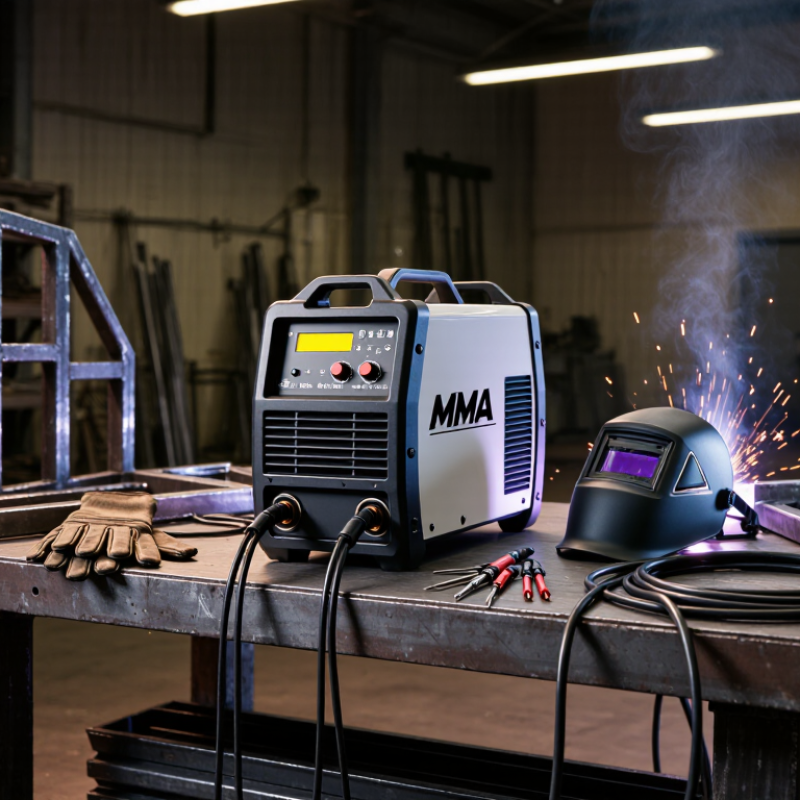
Define MMA/SMAW and AWS A5.1 Electrode Classes E6013 and E7018
MMA, also called SMAW or stick welding, creates an arc between a flux-coated electrode and the workpiece. The coating forms shielding gases and slag as it melts, protecting the weld pool. No separate shielding-gas cylinder is needed. AWS A5.1/A5.1M, the specification for carbon-steel SMAW electrodes, defines the familiar E6013 and E7018 classifications. In each code, E means electrode; 60 and 70 indicate minimum tensile strengths of 60,000 and 70,000 psi. The next digit, 1, identifies all-position capability. The final digits describe coating and current characteristics. Read the full AWS classification, not just the strength number.
E6013 is often chosen for light fabrication and general repairs. It tends to start easily and produces a smooth bead on clean steel. E7018 is a low-hydrogen electrode with iron powder in its coating. It is commonly used where stronger weld metal and reduced hydrogen risk matter, provided rods stay properly dry. A damp rod can undermine the plan. On a workbench, the difference is practical: E6013 may feel forgiving on thin stock, while E7018 usually calls for steadier technique and storage discipline. These are tendencies, not guarantees; joint design, base metal, and procedure still matter. For choosing an MMA machine in 2026, match its output range and duty cycle to the electrode and work, rather than treating one class as universally best. The code helps, but it does not choose for you.
Read 20%, 60%, and 100% Duty Cycles as Weld Minutes per 10-Minute Cycle
For the best MMA welding machine in 2026, compare duty cycle at the current you will actually use. IEC 60974-1:2017 rates welding power sources over a 10-minute period under specified test conditions. A 20% duty cycle means two minutes welding, then eight minutes cooling. At 60%, that becomes six minutes welding and four minutes cooling. At 100%, the machine can weld for the full ten-minute period at its stated rating.
That’s the practical read.
A 200-amp rating at 60% does not mean six minutes at every setting. Duty cycle changes with output current, and ambient temperature and ventilation can affect real-world performance. Check the specification for the exact amperage and test conditions; compare machines at the same output, not by peak amperage alone. Pauses for fitting or repositioning may give the machine time to cool, but they are not a substitute for its rated conditions. I’d look for a comfortable margin above my usual workload. It is easy to fixate on the largest number. The reference here is the International Electrotechnical Commission’s IEC 60974-1:2017, the standard for arc-welding equipment.
Compare Rated Amps at 40°C Using IEC 60974-1 Duty-Cycle Data
Which Is the Best MMA Welding Machine in 2026?
Compare Rated Amps at 40°C Using IEC 60974-1 Duty-Cycle Data
The best MMA welding machine is not always the model with the highest advertised amperage. A reliable comparison starts with rated output at 40°C, tested under IEC 60974-1 duty-cycle conditions. This standard commonly measures a ten-minute cycle. A 60% duty cycle at 200 A means six minutes of welding and four minutes of cooling.
Check the rating plate carefully. One machine may provide 200 A at 60%, while another reaches 200 A at only 25%. The difference becomes obvious during long fillet welds. Cables stay warmer, the cooling fan runs harder, and thermal protection may interrupt work. I have found that stable output matters more than a brief maximum reading. Still, workshop ventilation and actual mains voltage can change results.
Electrode size also affects practical performance. A 2.5 mm electrode usually needs less current than a 4.0 mm electrode, leaving more thermal reserve. Compare rated amps, duty cycle, input power, and protection limits together. Do not rely on peak amperage alone. That figure can look impressive.
Some published tables remain difficult to interpret. They may omit input conditions or show different test temperatures. That deserves caution. For field repairs, a machine rated at 160 A continuously can be more useful than one claiming 250 A briefly. My own comparison method is not perfect, but matching identical IEC data gives a fairer starting point.
Match Input Voltage, Electrode Diameter, and Output Current to the Job
Which Is the Best MMA Welding Machine in 2026?
Choosing the best MMA welding machine in 2026 starts with matching three numbers to your actual work. Input voltage must suit the available outlet, such as 120V, 230V, or dual-voltage power. A mismatch can cause weak arcs, overheating, or repeated circuit trips. Check the workshop supply before comparing features. Portable generators also need enough stable power, not just a matching voltage label.
Electrode diameter determines the current demand and weld size. A 2.5 mm electrode commonly suits light repairs and thinner steel. A 3.2 mm electrode needs more current and supports stronger structural joints. Larger electrodes can deposit metal faster, but they also create more heat. I once selected an electrode by appearance rather than material thickness. The weld looked acceptable, yet the heat distorted the workpiece.
Output current should cover your regular electrode range without operating at its limit. For many general repairs, a machine offering roughly 20–160A provides useful flexibility. Heavy steel may require higher output, while thin sheet needs careful low-current control. Check the stated duty cycle as well. A machine rated at 160A may not sustain that output continuously. Short welding runs can hide this weakness. Leave room for imperfect technique, dirty steel, and voltage drops. Test the arc on scrap metal before starting the final joint.
Which Is the Best MMA Welding Machine in 2026?
Match input voltage, electrode diameter, and output current to the job.
These are typical starting ranges; the required current varies by electrode type, welding position, and manufacturer. Check the electrode packaging and machine manual. Before choosing a machine, confirm its input voltage matches the available supply and that its rated output and duty cycle suit the job.
Rank 2026 MMA Machines by Arc Stability, Safety, Portability, and Value
For 2026, the strongest all-round MMA choice is a 160–200 A inverter with stable low-current output, adjustable arc force, and a clear duty-cycle rating. Rank 1 goes to this balanced class: it handles common 2.5–3.2 mm electrodes without becoming a burden to carry. Rank 2 is a lighter, lower-output unit for repairs and occasional work; it may struggle on thicker steel. Rank 3 is a higher-output machine for demanding jobs, but extra amperage can mean more weight and cost. Check arc starts with the electrodes you actually use. A paper ranking cannot replace a test weld.
Safety deserves more than a checkbox. OSHA sets an eight-hour exposure limit of 5 µg/m³ for hexavalent chromium, a hazardous fume component produced during some welding tasks. Ventilation and suitable protective equipment matter regardless of machine price. Compare duty-cycle figures at the same amperage, and look for thermal-overload protection, stable output, and clear input-power requirements. Value means reliable operation for your workload, not the lowest sticker price.
Tips: Before buying, strike several short beads on clean scrap, then repeat with a slightly rusty surface. Notice whether the arc starts cleanly and stays steady. Confirm your outlet can support the machine’s input demand. One honest caveat: advertised portability can feel different after carrying cables, electrodes, and protective gear across a worksite.
Which Is the Best MMA Welding Machine in 2026? — Rank 2026 MMA Machines by Arc Stability, Safety, Portability, and Value
Comparison of common MMA (stick/SMAW) inverter machine types, not individual products. Rankings and scores are editorial category-level assessments; specifications are typical indicative ranges and vary by model. Check the manufacturer’s nameplate and manual before purchase.
| Rank | Machine type | Arc stability
(1–5) | Safety potential
(1–5) | Portability
(1–5) | Value
(1–5) | Typical output and input | Best suited to |
| 1 | General-purpose 160–200 A inverter | 4 | 4 | 4 | 5 | Commonly 230 V single-phase; roughly 20–200 A, depending on model. | Most home workshops, repairs, and general mild-steel work. |
| 2 | Dual-voltage 120/230 V inverter | 4 | 4 | 4 | 4 | Accepts 120 V and 230 V on compatible models; maximum current is typically lower on 120 V. | Users who need to work at sites with different available supplies. |
| 3 | Compact 120–140 A inverter | 3 | 3 | 5 | 4 | Often designed for 120 V input; usable current and electrode size depend on the supply and duty cycle. | Light repairs, occasional use, and jobs where low weight matters most. |
| 4 | 200–250 A shop-duty inverter | 4 | 4 | 2 | 3 | Generally requires 230 V or another supply specified by the manufacturer; rated output depends on duty cycle. | Regular workshop use and higher-current electrodes, where the electrical supply is adequate. |
| 5 | Basic entry-level 100–140 A inverter | 3 | 3 | 4 | 5 | Input voltage and maximum output vary; check the rating plate, plug, and required circuit capacity. | Beginners and occasional, light-duty repairs with a limited budget. |
How to interpret the scores: 1 = lower and 5 = higher for the machine category. Arc behavior depends on the power source, electrode, settings, and operator. Safety scores indicate potential features, not a guarantee: confirm applicable electrical compliance, thermal overload protection, and whether voltage-reduction device (VRD) protection is provided and enabled. Compare duty-cycle ratings at the same ambient temperature and output current; do not infer continuous output from the maximum-current figure alone.