2026 Top Stackable Battery Storage Factory Guide
A stackable battery storage factory is more than an assembly line. It is where cell selection, module design, battery management systems, thermal control, and quality checks come together. In 2026, buyers will need to look beyond production capacity. They should examine how a factory verifies cell consistency, tracks components, tests finished units, and documents performance. Small details matter. A clear label on a battery module can make later inspection easier; a weak traceability process can make a fault harder to investigate.
This guide explores the practical questions behind choosing a stackable battery storage factory, including manufacturing capability, customization, safety testing, and after-sales support. It also considers the trade-offs between compact designs, flexible capacity, and long-term serviceability. A neat product photo cannot prove dependable production. Ask for evidence, and check what each test actually covers.
No source articles or verified expert quotation were provided. To protect accuracy, this introduction does not attribute an invented statement to a named specialist. A sourced quote from a battery-storage engineer or factory quality expert should be added once its wording and attribution can be confirmed. That matters. Trust should come from verifiable details, not a polished claim.
What Stackable Battery Storage Systems Are and How They Work
A stackable battery storage system is built from separate battery modules placed in a rack or secure cabinet. Each module stores direct-current energy, while an inverter converts it into alternating current for household circuits. Adding modules can increase usable capacity, but only within approved voltage, current, and communication limits. Modules are not universally interchangeable. Check before stacking. A battery management system monitors cell voltage, temperature, and charge levels, helping prevent damaging operating conditions. It may also balance cells so the pack uses its capacity more evenly.
During charging, energy from solar panels or the grid enters the battery through compatible power electronics. When demand rises or the grid is unavailable, stored energy flows through the inverter to selected circuits. Backup duration depends on the load, usable capacity, temperature, and conversion losses. A refrigerator and lights draw far less than electric heating equipment. That difference matters. A practical design review checks peak power as well as kilowatt-hours, cable ratings, clearances, and commissioning settings. The modular idea is convenient, but the wiring is not automatically simple; compatibility and installation details deserve a second look.
2026 Top Stackable Battery Storage Factory Guide: What Stackable Battery Storage Systems Are and How They Work
Illustrative nominal-capacity example using identical 5 kWh battery modules. Actual system capacity and usable energy depend on the selected modules, inverter, and system limits.
How it works: Stackable systems combine compatible battery modules to increase nominal storage capacity. A battery management system monitors the modules, while a compatible inverter manages energy flow between the batteries, the building, and the grid. Usable energy may be lower than nominal capacity.
Core Components and Configurations of Stackable Battery Systems
A stackable battery system is built from repeatable modules, but the stack is more than cells in a cabinet. Cells store energy; module frames hold them in place and help manage heat. A battery management system monitors voltage, temperature, and state of charge. Small parts matter. Busbars, fuses, contactors, and sensors support safe current flow and fault isolation. A power conversion system links the battery’s direct current to an alternating-current load or grid.
Modules may connect in series to raise voltage, or in parallel to increase capacity and available current. The right arrangement depends on the inverter’s operating window, site load, and expansion plan. Thermal control may use air or liquid cooling, while the enclosure adds mechanical protection and service access. Wiring diagrams should show isolation points clearly. A tidy-looking stack can still hide difficult maintenance.
The International Energy Agency’s Batteries and Secure Energy Transitions report says battery storage capacity additions reached about 42 GW in 2023, more than doubling from 2022. That growth makes modular design increasingly relevant, but market expansion does not prove every stack is well engineered. One detail deserves a second look: adding modules later may require compatible voltage ranges, communication protocols, and matching operating limits. These constraints are easy to underestimate during factory selection.
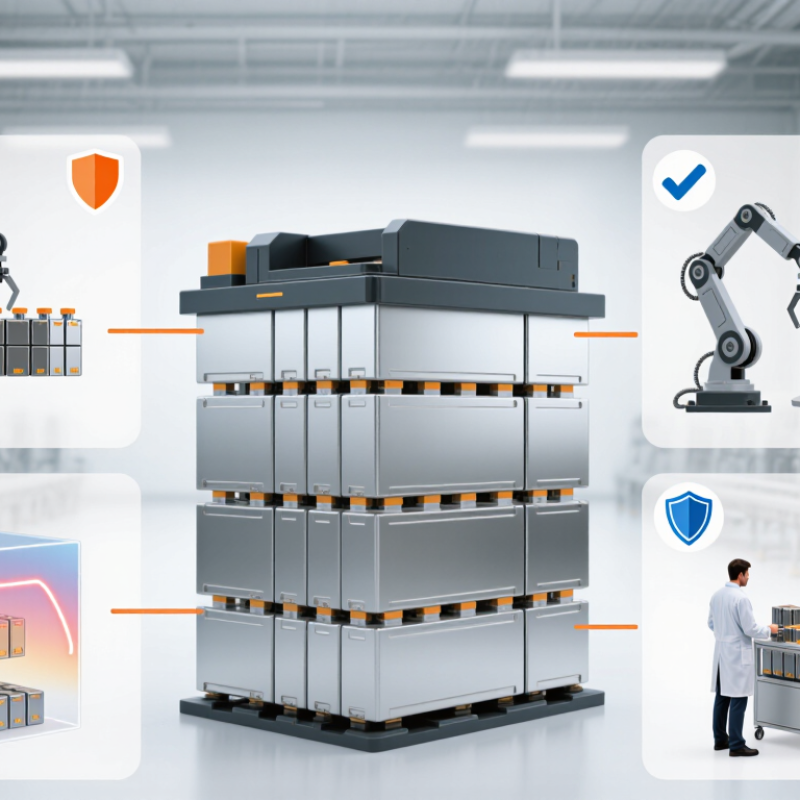
How Factories Manufacture and Test Stackable Battery Storage
A stackable battery storage unit begins with cell inspection, not final assembly. Technicians check cell voltage, appearance, and measured resistance, then compare results across each batch. Cells that differ too much may create uneven performance later. Matching them takes time.
Workers assemble cells into modules using fixtures that keep spacing consistent. They fit insulating sheets, connect busbars, and tighten fasteners to specified torque values. A loose connection can heat under load. Each module receives a serial record linked to its inspection results. The enclosure and stacking joints are checked for alignment, since a small mismatch can make installation awkward. It happens.
After assembly, factory technicians connect the battery management system and verify sensor readings, wiring polarity, and communication between modules. They run controlled charge and discharge cycles while recording voltage, current, and temperature. A thermal camera may reveal a warm terminal that ordinary visual checks miss. Not every defect appears during one test, though.
Final checks can include insulation resistance, protective-function tests, and repeated operation at different loads. Results are compared with the product’s design limits, not guessed from appearance. Factories should retain test data and investigate failures before releasing a unit. A clean test report is useful, but it cannot predict every condition in the field. That limitation deserves attention.
How to Evaluate Stackable Battery Storage Factories in 2026
2026 Top Stackable Battery Storage Factory Guide
How to Evaluate Stackable Battery Storage Factories in 2026
A factory tour should reveal more than polished sample units. Ask how workers check cell dimensions, terminal connections, and insulation during assembly. Request records from recent production batches, not just a demonstration report. Details matter. Confirm that the battery management system is tested with the intended inverter and that protection settings are documented. A clean production line helps, but it does not prove consistent quality.
Evaluate test methods against your operating conditions. Ask for capacity and cycle-life results with stated temperature, charge rate, and depth of discharge. Compare these assumptions with your project; a result from mild indoor conditions may not reflect a cold, dusty site. Inspect enclosure seals, cable routing, and stack connectors on a finished unit. Small assembly flaws can become service problems. Review warranty terms, replacement procedures, spare-part availability, and response times. A factory may have strong equipment yet weak support. That gap is easy to miss.
Tips: Ask to trace one sample unit from cell batch to final test. Check whether serial numbers connect to inspection records. Request written limits for temperature, current, and installation clearance. If evidence is incomplete, note what remains unverified rather than treating a confident sales answer as proof.
Applications, Safety Standards, and Technology Trends for 2026
Stackable battery systems suit homes with changing energy needs, small workshops, and remote sites with limited grid access. Each module can add capacity without replacing the entire cabinet. A homeowner might begin with evening lighting and refrigeration, then expand storage after adding an electric vehicle. In a workshop, peak-shaving can help manage brief loads from pumps or tools. Fit is not automatic. Floor space, inverter limits, and local installation conditions still matter.
Safety depends on design and installation, not a label alone. Ask whether cells and complete systems have been tested to relevant standards, such as IEC 62619 or UL 9540, where applicable. Requirements vary by market and system configuration. Check the battery management system’s protection against overcharge, deep discharge, and excessive temperature. Look for clear spacing guidance, cable ratings, isolation procedures, and accessible emergency instructions. Details matter. A neat stack can still be unsafe if airflow is blocked or connections are poorly secured. Factory quality records and traceable end-of-line tests are worth reviewing, though paperwork cannot replace independent verification.
For 2026, expect more modular controls, improved monitoring, and tighter coordination between batteries, solar inverters, and home energy software. Better diagnostics may flag a drifting module before it limits the whole stack. That sounds useful, but alerts need to be understandable and actionable. Some systems still make routine troubleshooting harder than it should be. Ask how firmware updates are managed, what data is stored, and whether modules of different ages can operate together. These details can shape long-term service costs.