
Reliable backup power is becoming more important as electricity systems face rising demand, extreme weather, and uneven grid access. The International Energy Agency’s Electricity 2024 report forecasts global electricity demand growth of about 3.4% annually from 2024 to 2026. Its analysis also highlights expanding consumption from data centers, industry, cooling, and electrified transport. These pressures make Open Frame Generator Sets relevant for construction sites, farms, workshops, telecom facilities, and emergency applications.
Built for visibility and service access, open-frame units allow technicians to inspect the engine, alternator, fuel lines, and control panel quickly. That practical advantage matters in dusty sites or remote regions. The U.S. Energy Information Administration’s International Energy Outlook 2023 also emphasizes differing energy conditions across markets, including fuel availability and infrastructure gaps. A suitable generator therefore requires more than rated kilowatts. Buyers should compare prime and standby ratings, voltage, frequency, alternator quality, automatic voltage regulation, fuel consumption, noise output, and spare-parts support. ISO 8528 provides a useful technical reference for generator-set performance and testing.
Details decide reliability.
This guide evaluates leading 2026 models for global buyers, considering operating conditions rather than brochure claims alone. Some comparisons remain imperfect because manufacturers publish different test methods and load assumptions. That limitation deserves attention. A compact 20 kVA machine may suit a workshop, while a 500 kVA set may support a larger commercial load, but neither is automatically the better choice. The strongest purchase balances lifecycle cost, serviceability, emissions requirements, local technical support, and dependable performance under real operating conditions.
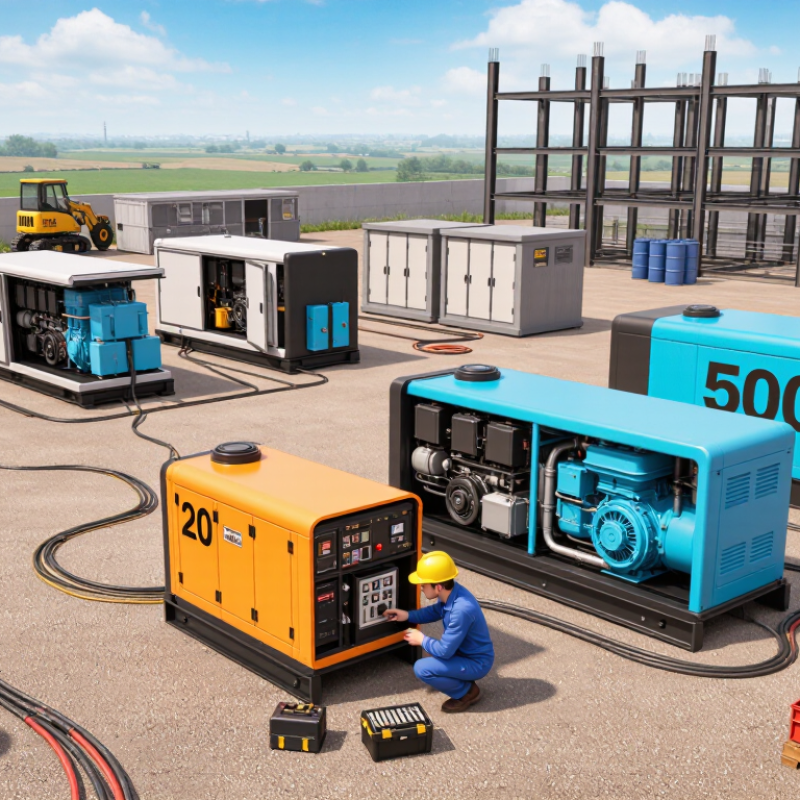
2026 Best Open Frame Generator Sets for Global Buyers
An open frame generator set exposes its engine, alternator, radiator, and control panel. This design improves inspection and routine servicing. Technicians can reach filters, belts, terminals, and hoses without removing heavy panels. The trade-off is clear: open frames offer limited protection from rain, dust, and severe weather. Noise is also higher. According to the International Energy Agency’s Electricity 2024 report, global electricity demand may grow by an average 3.4% annually from 2024 to 2026. Reliable backup equipment therefore matters for construction sites, farms, workshops, and temporary facilities.
The working process is straightforward. The engine converts diesel or gas energy into rotational force. The crankshaft turns the alternator rotor. Magnetic movement then produces electrical current in the stator. An automatic voltage regulator helps control output stability. The controller monitors frequency, oil pressure, coolant temperature, and battery condition. When utility power fails, a transfer switch can connect the load. Selecting only by kVA is a common mistake. Starting currents, altitude, ambient temperature, and continuous operating hours also affect performance. I would check these details before comparing prices.
Tips: Confirm the required voltage and frequency before ordering. Leave ventilation space around the radiator. Use an enclosure when weather or noise control matters. Check ISO 8528 performance requirements and local installation rules. A canopy may improve protection, but it can restrict airflow and complicate maintenance. That compromise deserves practical testing, not assumptions.
Selecting the best open frame generator set in 2026 requires more than comparing rated power and price. In field assessments, I check continuous output, standby output, voltage stability, and response during sudden load changes. A workshop motor can demand several times its running current. The set must handle that event without unacceptable voltage dips. Confirm the required phase, frequency, and voltage before ordering. Small errors create expensive delays.
Operating conditions deserve equal attention. At 1,500 meters, thin air can reduce engine performance. High humidity, dust, and temperatures above 40°C also affect cooling and filtration. Ask for documented derating curves, fuel consumption at 25%, 50%, and 75% load, and tested noise data. Service access matters. A technician should reach the oil filter, battery, control panel, and radiator without dismantling half the frame. That detail is often ignored.
Safety and compliance cannot be treated as paperwork. Review grounding provisions, emergency shutdowns, guarding, exhaust routing, and local emissions requirements. Check whether test reports come from a qualified laboratory. I also compare spare-parts availability and technician training in the destination country. Cheap ownership is not always cheap maintenance. No checklist is perfect. Real site measurements may still expose assumptions, especially where loads change unpredictably. A practical trial under representative conditions remains the most reliable evidence before large-scale purchasing.
Open-frame generator sets serve different loads, environments, and operating habits. Small 1–5 kW petrol units suit lighting, tools, and emergency home circuits. Their exposed frames improve access but increase noise and weather risk. Mid-range 5–20 kW diesel sets support small workshops, retail spaces, and rural equipment. Larger 20–100 kW models fit construction sites, farms, and temporary commercial power. Above 100 kW, buyers should consider industrial sets with stronger cooling systems and longer-duty components. These categories are practical guides, not fixed rules. Actual output depends on altitude, temperature, fuel, and load type.
The International Energy Agency’s Electricity 2024 report projects global electricity demand growth of about 4% annually through 2026. That growth increases demand for flexible backup power. Motor loads need extra starting capacity. Pumps and compressors can briefly draw two to seven times their running current. A 10 kW running load may therefore require a 15 kW or larger generator. Oversizing also wastes fuel at light loads. This is where many purchasing decisions become less precise.
Tips: List running watts and starting watts separately. Add 20% spare capacity. Check voltage, phase, frequency, and local service access. Use ISO 8528 performance guidance when comparing specifications. Test the set under realistic loads, not only at idle. An open frame is rarely ideal outdoors without a weather shelter. That detail is easy to miss.
Choosing the best open frame generator set requires more than comparing rated output. Global buyers should confirm voltage, frequency, phase, and control-panel requirements before requesting a quotation. Standards differ by destination, so ask for complete test reports, technical drawings, and conformity documents. Certification alone is not enough. The documents must match the exact engine, alternator, and configuration being shipped.
Fuel selection also affects reliability. Diesel quality, storage conditions, ambient temperature, and service intervals can change operating performance. A generator designed for one market may need different filtration or cold-start provisions elsewhere. Shipping details deserve equal attention. Confirm lifting points, crate dimensions, gross weight, corrosion protection, and customs paperwork. A missing packing list can delay a shipment for days. That is expensive.
Tips: Request a pre-shipment inspection with load testing. Keep photos of serial plates and packed components. Ask whether common filters, belts, and sensors are available locally. Remote commissioning support is useful, but it cannot replace clear manuals and trained technicians. After-sales response time should be written into the purchase agreement, including spare-parts availability and troubleshooting procedures. No checklist is perfect. Site conditions may still expose assumptions, especially in dusty, humid, or high-altitude locations. Buyers should leave room for technical review before final payment.
| Generator Class | Electrical and Operating Specifications | Standards and Compliance | Fuel and Runtime | Shipping Considerations | Support Priorities | |||||||||
|---|---|---|---|---|---|---|---|---|---|---|---|---|---|---|
| Typical Prime Power | Common Voltage | Frequency | Typical Use | Safety Standard | Quality Standard | Emissions Note | Fuel Type | Typical Fuel Use at 75% Load | Typical Runtime | Approx. Shipping Weight | Approx. Shipping Footprint | Container Planning | ||
| Small Portable / Light Commercial | 5–20 kVA | 230/400 V, 3-phase; 120/240 V options | 50 or 60 Hz | Small worksites, retail backup, pumps, and temporary power | IEC 60204-1; local electrical installation rules | ISO 8528 for engine-generator performance; ISO 9001 is commonly requested for manufacturing control | Emission requirements depend on the destination country and engine category; confirm certification before shipment | Diesel; gasoline models are also available in the lower-output range | Approximately 1.5–4.5 L/h for diesel units | Typically 8–12 hours with a standard tank | 180–650 kg | Approximately 1.2–1.8 m² floor area | Usually suitable for consolidated cargo or small crate shipments; protect control panels and alternators from moisture | Local spare filters, battery support, wiring diagrams, and clear startup instructions |
| 20–60 kVA | 20–60 kVA | 400/230 V or 480/277 V, 3-phase | 50 or 60 Hz | Construction sites, farms, offices, and small commercial facilities | IEC 60034; IEC 60204-1; destination-country electrical codes | ISO 8528; factory testing should include voltage, frequency, load response, and insulation checks | Some markets require certified non-road diesel emissions compliance; requirements may differ for standby and prime applications | Diesel | Approximately 4–13 L/h at 75% load | Typically 8–16 hours, depending on tank size and load profile | 600–1,800 kg | Approximately 2–4 m² floor area | Check forklift pockets, lifting points, crate dimensions, and maximum allowable gross weight for inland transport | Regional service coverage, automatic transfer-switch compatibility, and replacement battery availability |
| 60–150 kVA | 60–150 kVA | 400/230 V or 480/277 V, 3-phase | 50 or 60 Hz | Medium construction projects, hotels, workshops, and backup power systems | IEC 60034; IEC 61439 may apply to associated low-voltage assemblies | ISO 8528-5 for generating-set performance; documented load-bank testing is recommended | Verify the applicable stage or national emissions rule, especially for continuous operation in urban areas | Diesel | Approximately 12–32 L/h at 75% load | Typically 8–24 hours with an extended base tank | 1,500–3,800 kg | Approximately 4–7 m² floor area | Confirm whether the set can ship as breakbulk, flat-rack, or containerized cargo; account for service access around the unit | Commissioning assistance, load-bank testing, controller configuration, and preventive-maintenance schedules |
| 150–300 kVA | 150–300 kVA | 400/230 V, 415/240 V, or 480/277 V, 3-phase | 50 or 60 Hz | Factories, data and telecommunications sites, hospitals, and large commercial buildings | IEC 60034; IEC 60529 enclosure protection may apply to control equipment | ISO 8528-5; testing should cover transient voltage, frequency recovery, and step-load performance | Emission certification, exhaust design, and after-treatment requirements must be checked for the final installation location | Diesel | Approximately 30–65 L/h at 75% load | Typically 8–24 hours; external fuel systems may be required for longer autonomy | 3,000–6,500 kg | Approximately 7–12 m² floor area | Pre-shipment dimensional drawings are essential; review crane capacity, door clearance, and port handling limits | 24/7 technical escalation, controller spare parts, remote monitoring integration, and trained commissioning personnel |
| 300–800 kVA | 300–800 kVA | 400/230 V, 415/240 V, or medium-voltage output through a transformer | 50 or 60 Hz | Industrial plants, large infrastructure projects, utilities, and mission-critical facilities | IEC 60034; IEC 61439 for low-voltage switchboards; local fire and fuel-storage regulations | ISO 8528-5 with witnessed factory acceptance testing recommended for critical applications | Local emissions limits may require selective catalytic reduction, diesel oxidation catalysts, particulate controls, or operating permits | Diesel | Approximately 60–170 L/h at 75% load | Typically 8–24 hours using dedicated day tanks or bulk-fuel systems | 6,000–15,000 kg | Approximately 12–25 m² floor area | Route surveys, lifting plans, customs documentation, marine insurance, and oversized-cargo permits may be required | Multi-year parts planning, field service agreements, synchronization engineering, and operator training |
| 800–2,000 kVA | 800–2,000 kVA | Low-voltage or medium-voltage output, subject to project design | 50 or 60 Hz | Power stations, mining, large manufacturing, hospitals, and data-center campuses | IEC 60034; IEC 61439; applicable grid-interconnection and protection requirements | ISO 8528-5; full-load and step-load factory acceptance testing should be contractually defined | Permitting, exhaust dispersion, acoustic limits, and fuel-storage rules can materially affect the project design | Diesel; gaseous-fuel alternatives may be evaluated for fixed installations | Approximately 160–420 L/h at 75% load | Normally designed around an engineered bulk-fuel system rather than an integral tank | 12,000–35,000 kg | Approximately 25–60 m² floor area, excluding service clearances | Project logistics should include route engineering, port lifting capability, modular shipment planning, and on-site assembly | Guaranteed response times, regional parts inventory, remote diagnostics, protection studies, and long-term maintenance support |
2026 Best Open Frame Generator Sets for Global Buyers
Installation determines reliability more than brochure ratings. Place the set on a level, reinforced pad with drainage beneath it. Keep exhaust outlets away from doors, windows, and air intakes. ISO 8528-5 recommends evaluating performance under defined load conditions, not only standby power. Measure voltage, frequency, grounding, and load balance during commissioning. A poorly sized generator may run cold, wet-stack, and consume more fuel.
Safe operation requires visible controls, guarded hot surfaces, emergency shutdown access, and documented transfer procedures. Operators should inspect fuel lines, coolant levels, battery terminals, and ventilation before every start. The U.S. Department of Energy’s Operations and Maintenance Best Practices Guide reports that structured maintenance can reduce energy use by 5–20% in suitable facilities. That figure is not a guarantee for generator sets. Still, it supports disciplined inspections. I would not trust a low-hour machine without service records.
Tips: Record fuel use at 25%, 50%, and 75% load. Compare these figures monthly. Clean dust from radiators. Test batteries before winter. Include filters, coolant, testing labor, transport, noise controls, and eventual disposal in lifecycle costing. The International Energy Agency’s 2024 energy-efficiency analysis shows efficiency progress remains uneven globally, so local fuel prices and grid conditions matter. A cheaper purchase can become expensive after five years. This is where buyers often underestimate reality.
Ten-year lifecycle cost model for a typical 100 kVA open-frame diesel generator operating at 75% load for 500 hours per year. Values are in USD and exclude taxes, financing, and fuel-price inflation.
Planning assumptions: 80 kW average electrical output, 20 L/h diesel consumption, diesel price of $1.25/L, 400,000 kWh generated over ten years, scheduled maintenance allowance of $0.06/kWh, and one major overhaul reserve.
To learn more about any of the products and services provided by Abbott Ball Company, Inc., simply complete the form below.